How to Write About Pain

For a few days now, I’ve been writing about the experience of chronic pain, in a descriptive way that might convey the experience to someone who’s never lived with it before, and also as a comparison against acute/short-term pain, beyond their obvious difference in duration. I think I finally came up with a good analogy to depict the experience of daily pain, the internal battle it becomes, the consuming and exhaustive nature it takes on. But I’m not going to write about that yet. Because also for the last few days, I’ve been questioning why I’ve taken the time to try and get this very unique experience across anyway. I’ve wondered whether it’s futile in the first place, but more I’ve been reflecting on whether the point in it is genuine; if I’m doing a service of any kind, or if my ego has found a formal way to complain. Like Tolle says, that is the ego’s favorite thing to do.

As an FYI, I’ll post about chronic pain next time, because I do actually think it’s important to explore for many reasons, especially if you’ve not been through it. And I’ll write more about why when I come there. But first I had to type out loud, because I question the morality of what I do–writing about my broken body and the battles that accompany it–or if there is any in it, all the time. I constantly ask whether I’m evolving, learning anything, or passing good things along, important things. Or if I’ve sunk to the lowest common denominator of the human experience, something literally everyone goes through in his life, and if it’s just too easy to make that a goal and have it blinded by ego.

I always worry about going too far into how “bad” things can feel. Sometimes, there is truly no point in bemoaning something you can’t control, and it doesn’t help anyone to go on and on about any matter of it. In fact it can easily make things worse, redirecting the mind to focus on negative aspects and intensifying the size of something that you are trying to keep small, in check. Not to mention, you’ll bore everyone to tears. No one likes a whiner, and I try to be cautious about keeping the line drawn, bold and underlined between the two pathways the narrative can take:

One describes an experience so that people on the outside might have a better idea of what his fellow humans are dealing with. It can help expand “common ground”, I think. If it’s done a very good job, it might help replace judgment with compassion, or prevent misunderstanding or a lack of empathy due to disbelief that it’s even real. It helps close the gap between the experiences of two people who have not lived in the others world.

lifejustisntfairnowisit_d9c0a33f9be96e6ce36748350b45b573
Guilty
The other path, takes pain and gives it too much of a stage. It exploits something that all humans go through in some capacity and disguises itself as some kind of cursed reward. It gains momentum by reliving the same woes with new words, and by getting others indulge in their own without reflection. It’s not adding anything new or valuable to the conversation. If it isn’t honest or asking for help, if it isn’t uplifting people, but just reinforcing old wounds, it’s fair to say it’s gone south. Ever notice how someone complaining can rub off on you and lead you to do the same, or simply leave you feeling depressed? I’ve experienced it in person, and I know writing and reading accounts can be just as powerful.

Similarly, a positive person, who still acknowledges reality but seems to see through their moment of pain, can leave you feeling hopeful and inspired. The difference is not that these people haven’t endured pain, but what they’ve done with it. How they chose to let it shape them.

I know I’ve crossed over into the negative side way more than I’d like to admit, and probably even fooled myself into thinking it was necessary. Talking about hardship will always draw people in, because we’re all being challenged in our own ways, carrying our unique burdens. But that’s why I scratch half these posts or become too afraid to write about things. It’s a necessary and good thing to talk about the realities we face, because so often it provides people reinforcement, encouragement, reminders they are not alone and the vital belief that they can endure their hardship, just as many before them have, and emerge on the other side. Reading other peoples stories has always inspired and comforted me. Sometimes I distrust myself and skip out on telling certain stories or of certain experiences, but I think maybe it takes practice in reading enough good stories, and knowing the difference between which one will do good, and which one is the ego getting his fill.

I pray constantly to be a source of optimism through honesty, not to exploit a reality that’s in comparison to some, very very lucky. I think you write about pain the same way you live with it, which is to keep in checked moderation and right sized, and attempt to keep eternity in view, somehow. I don’t know how to do this, but I know some good ways not to. So what can I do but try and hope that I’m on the right side of sharing a personal account. Usually if I become too whiny, my mother hits me. Kidding– but you have a big enough family and they don’t let you complain too long or past a certain point, so I’ve relied on them often to keep me in check. A good friend will do the same.

What I’ve learned so far is how easy it can be to start expecting things to go bad, because so many things go bad. But we do ourselves a disservice in becoming convinced the world has conspired against us and we’re doomed to draw the short end of the stick for the rest of our lives. The trouble with that kind of thinking, besides it having no intrinsic value, is that it assumes the rest of the world is riding the easy train to party-town, never confronting a hardship, enduring pain, or drawing their own crappy short sticks. No one has a monopoly on pain. It’s part of all our respective contracts here. So having the idea that your life is hard and everyone else is clueless and has it easy will only make your own pain worse by punctuating it with something that isn’t true, first. And second, that idea undermines the lives of others who do know pain good and well, but whose experience you are now denying, because you can’t see past your own. I cringe to consider how many times I’ve done this, being stuck in my own dark hole.

Pain can be blinding or clarifying, depending on how well it’s kept in check. It can be overwhelming in the moment but when held against the larger backdrop of our lives, it usually highlights what is good, it makes gratitude grow and can help you see with new eyes. If pain is held up only in its moment in the dark, and seen as punishment, bad luck, or some kind of payment you got stuck with and others are getting for free as though its some kind of tax, then you will pay continually, and your relief will be rare. Pain shouldn’t make us proud, it should show us humility. Acting well and grateful and good in the face of pain is what should make us proud.

Sometimes I think of my life from a birds eye view, looking at it plotted out on paper like a map, where I can trace with my finger through the course, beginning to end. When I get discouraged, I think that what I fear is living a life I can’t say that I’m proud of in the end, when I’m tracing my line and seeing how I behaved. I know what will make me proud is having loved fiercely, being steadfast, humble, trying, listening well, finding humor in every stupid day, and being grateful for the lucky life I was given, the family of love I was born into. In the meantime, it feels good to put your head down and work. Sometimes you endure the pain quietly, and know that you’ll be OK whether you tell someone about it or not. I think moderation plays a role, and a discernment in what is worth sharing and what will only exhaust us to speak about. In some way it comes down to self-awareness and restraint.

I’ll end with this passage I read in The Road to Character this morning, a book I’d highly recommend by David Brooks. The first quote is Brooks summarizing George Marshalls training at VMI, followed by a quote from Cicero, which Brooks used to explain the composed, revered manner of Marshall throughout his life.

“The whole object of VMI training was to teach Marshall how to exercise controlled power. The idea was that power exaggerates the dispositions–making a rude person ruder and controlling person more controlling. The higher you go in life, the fewer people there are to offer honest feedback or restrain your unpleasant traits. So it is best to learn those habits of self-restraint, including emotional self-restraint, at an early age…

That person then, whoever it may be, whose mind is quiet through consistency and self-control, who finds contentment in himself, who neither breaks down in adversity nor crumbles in fight, nor burns with any thirsty need nor dissolves into wild and futile excitement, that person in the wise one we are seeking, and that person is happy.” -Cicero

Health, Happiness, Restraint

P.S. This is dedicated to Varney Prejean, the eternal optimist in the face of pain and such a happy, loving, groovy person. If you’ve got an extra prayer, send one out for him. Hang tough Varn-dog, we’re rooting for you!

Apathy, Advocacy, Jumping In

I remember a conversation I had with my mom, roughly six years ago. It was not long after the Great Crash of 2011. I was slumped at a bar stool in my parents kitchen. I’d been crashed a while and not doing very well, physically or mentally. It was a grey, wet Winter, perfectly depressing, and I remember looking out our office window and thinking “I feel exactly like the weather.” I’d been caged up too long, among other side effects. Everything was a reminder of what I’d lost, what I believed the disease took. I knew I should be grateful I had somewhere to go, and I had people to take care of me at all. Not everyone has that, no doubt I was lucky. But I didn’t want help. That kind of surrender is never really easy, but when you’re in need, it’s really the only way to go. Resistance just ends up making you mean to the people who are trying to help you.

My mom was folding laundry, explaining to me the details of a promising new study going on, something involving the gut; I wouldn’t know because I was barely listening. She told me that I should follow the research and recommended I read a blog called Phoenix Rising, a veritable A-Z of everything MECFS. It might help me feel better if I at least understood more about the disease, on many levels.

But I could almost feel a visceral resistance to this idea. Ironically, I didn’t like reading books or blogs or stories about this disease. They only reinforced what I already knew, and they all ended the same—no one got better. I can remember holding back tears, angry tears I guess, that I didn’t want to read anything about this disease again unless it was an article touting that they found a cure.

They?

(Insert really awkward DC photo)

DC
So terrible.
6 years later, I found myself frozen in the doorway of room 129 in the Rayburn Building in Washington D.C. I was attending an event called “The Storm on Washington“–an event I felt a strong pull toward for a few months.

This room would be our “MECFS Command Center” throughout the long day–a place to commune in between meetings and rest, eat, talk, or collapse. (Really, there were beds) I hadn’t even entered and already I could feel the warmth of the room from so many bodies insides, at least 10 degrees hotter than the icy hallway. It was 9 am and a low, indecipherable murmur pervaded the room from multiple conversations–introductions and instructions and attempts to achieve order among a really huge, logistical effort. I stood there like a lost puppy, watching the quiet chaos unfold. I knew not one person. What the hell am I doing here?

Doctor
Meeting the MAN, Dr. Nahle
I was doing what I’d done many times before–jumping in without a clue. But I was among smart and determined people. The principal reason for being there was pretty easy anyway–to share my story, to try and humanize this disease and convey the experience with decision-makers. I’d told my story plenty of times before, I’d become pretty practiced.  That day 52 advocates would meet with over 70 congressional offices and representatives. A success in just making that happen, in my book.  (Thank you MEAction and SolveMECFS!)

It feels like there have been many beginnings to my entrance into the advocacy world. A place I never thought I’d enter, for reasons I’m still unsure of now. Bitterness maybe. Fear probably. I still feel like I’m hardly making a dent, but I am trying, finally. Bitterness, self-pity, doubt–all of those feelings depleted me, when I was already emptied of energy. They still come around. But finding small glimmers of faith that you might be where you’re supposed to be, even if the circumstances are crap, feel energizing. Any time I’ve come across hope, it’s like a flashlight turning on in a cave. It’s somehow always led me out, even if very slowly. But it usually means some kind of surrender; giving it a chance. I don’t write this as though finding purpose in a painful situation is easy. It’s not. Particularly chronic illness, which is long-term. It took a long time to figure out that I could still even have one, as I was. I still lose my way from time to time, and wait for a flashlight to flick on that I can follow.

I didn’t know when I published the petition last year that I was entering the world of they. Nor did I really know what I was doing then either, surprise surprise. I was following intuition and telling the truth, that’s it. But the same energy that brought me to DC encouraged me to write it. Call it the universe, or God, the collective unconscious, or soul–something outside the 5 senses was helping me out. I just sort of followed the scent.

Admittedly, I’m bad at campaigning. Gary Zukav says that when our soul and our intentions are lined up, the universe backs us in big ways. Maybe that’s what happened when it gained something like 20,000 signatures in a day. I was also lucky that my sister does know how to campaign, and my enormous family, circle of friends and other advocacy groups pitched in, all in huge ways, and now that petition has 42,000 signatures. When I wrote it I had my fingers crossed it would reach 1000.

Did 42,000 signatures fix the problem? No. But it did something else important. It connected me to so many people through the feedback page, where people can leave comments. People shared their personal stories, their loved ones stories, gratitude and words of encouragement. Total strangers said they’d pray for this effort. Every time I read one of those comments it made me want to work harder. It showed me how far-reaching and devastating this disease can be.

I thought had it bad? Talk about small potatoes. The petition did two things: 1. Showed me I could have it a lot worse, so easy on the self-pity, chief. 2. Stopped me from looking the other direction. Coincidentally, that’s exactly what we’re asking the government to stop doing now.

It was the petition that led me to connecting with an MECFS advocate online, who knew the D.C. Aide for Bill Cassidy, a Louisiana State Senator. I contacted him, which led me to a meeting with Cassidy’s number 2 guy and the Louisiana State Director, Brian McNabb. Meeting with McNabb for 2.5 hours, discussing everything MECFS was an incredible experience. Did it change anything? Maybe not. But it encouraged me big time. And in the end it scored me a meeting with Senator Cassidy. McNabb warned, it would be in between two events so it’d have to be quick, maybe 5 minutes. I said I’d take it.

So, I met Bill Cassidy in a parking lot on his walk to his car with a group of staffers surrounding us.

Cass
Parking Lot Office
I had to talk fast as he was late to his next meeting and his assistant kept saying “Sir, you’re very late, we need to go.” I spat all the vital things out as fast as I could. Knowing I didn’t have long, I left him with a folder where I’d printed out 25 pages of peoples comments and stories that they’s shared on the petition page. Did he read them? I’ll never know. But he looked me in the eye, he shook my hand, and he told me out loud “I really care about this issue.” I told him thank you, I couldn’t express how much we needed people to care. He said he wanted to continue the conversation when he had more time. We were being herded like cattle to his waiting car. A cynic might say he probably says that to everyone, but it didn’t matter. Here was one more person who had now at least heard of this disease and the issues, and also had some decision making power. His assistant who had hurried us both while listening to our conversation, started to get in her car, but stopped, got out, and gave me a hug first. Good stuff.

Later, my uncle who is a mutual friend of Representative Steve Scalise, had seen my “Chronic Fatigue Syndrome Song” on the petition page–a mostly embarrassing but celebratory song I wrote after hitting 40,000 signatures. He thought it was pretty funny, and asked if I was interested in a sit down

Scalise
Obligatory Photo, Thanks Mr. Scalise
with Steve Scalise, a Louisiana Representative and the Majority Whip. Umm, yes. So not long ago, my Uncle Paul and political mentor, Rep Steve Scalise and I all sat down for a while to talk MECFS. He was another kind and engaged listener. He asked good questions and was generous with his time. I told him my story, I attempted to tell the story of MECFS among my hiccuping brain, and Paul helped me convey some things when my words turned to spaghetti mid-sentence.

Would this meeting solve it? No, but it was one more person who now at least knew of the disease. Someone with decision making power. Count it.

It was exactly one week after that meeting that Scalise and others were shot in a baseball field in the middle of the morning. What?! I am as clumsy with thoughts as I am words when it comes to events like that. It’s so hard to understand, it happens way too often, and I still feel far away from it somehow. As cliche as is, I’m praying and sending healthy thoughts his direction and the others injured that day. How this all plays out in history, we can’t know yet. Maybe someone is reading this in the year 2045, and it will all make sense.

Why am I writing this now? Because I need the reminder, which is very obvious but I want in words anyway, which is just to try. A reminder of how much happier I feel when I go for it, even when I don’t know what I’m doing. A reminder that writing 15 versions of this one stupid blog post over the course of a month is mostly a waste of time. Just jump in. It’s not always complicated. It will never be perfect, but it’s almost irresponsible not to try at this point, and to keep trying, over and over.

I continue to walk the thin line between fighting for a cause I whole-heartedly believe in, and surrendering to circumstance and the things I can’t control. I’m always learning , that a sick life can be a good life too–and I hope can still become a person I can say I’m proud of in the end. It’s easy to cross over too far one way or another, but if I stop trying, I’m a gonner. Sometimes I fail. There are many (funny) stories where I blow it. But it feels so much better to get out there and blow it, then to act like a bitter teenager on the sidelines, thinking pain was never a part of the deal. This is the reminder; try. You always feel better when you do, so do.

Health, Happiness, Tryin

Boots On the Ground 

Well yall, I made it.

I made it to Washington DC for our big advocacy day on the hill tomorrow. I made it through the last 6 weeks which were all kinds of difficult for all kinds of reasons. I made out with a guy, like high school style. Life is crazy! But I made it.

I will get into the last six weeks another time, but it feels more important to document what’s happening now– which is that a sick little Gelpi made her way to D.C. to play with the big boys. I can barely keep my eyes open writing this, but I’m ready. Anything, everything– I am finally where the magic happens and I know I need to make this a high impact and memorable trip–for them, not me.

Tomorrow is a big day. I can’t believe I’m in D.C. If you would’ve caught a glimpse of what was happening two hours before my flight was set to go, all odds would fall in favor of “Yeah there’s no way she’s making that flight.” Long story–another time. But here I am. And the process of arriving was not made any easier by my body, that reliable piece of shiznit, which fought me pretty hard the whole time I tried to make this happen. There was serious contemplation on backing out, and considering I bought the ticket to come here yesterday, this all happened fast, and felt like it could unravel just as quickly. But I knew, the way you seldom but with pure certainty know you have to do something– even if you don’t know exactly what that thing is, you just know you need to be there. Show up. Something in me knew I needed to show up — even if it resulted in nothing tangible or in “successful Numbers.” I needed to see and talk  to our politicians as the humans they are and not the dopes I see portrayed on tv. It’s easy to lose faith in our system, especially given the media coverage of Washington and the shitshow that it is. But I need to believe in all of this, because I know deep down there are actually good people out there– out here– working really hard to make things happen. These are the people we need on our team.

Despite Social media bringing public figures “closer” to us, and in some ways more accessible, there’s still a disconnect that just can’t be filled in except for that good ol fashioned thing known as actually talking to someone. I think I’m all tweeted out, as far as tweeting at strangers asking them to care about something they mostly don’t care about is concerned. So it’s already somewhat of a victory: just being in the battlefield, and seeing the whole system at work. Double checking they aren’t robots– that kind of stuff.

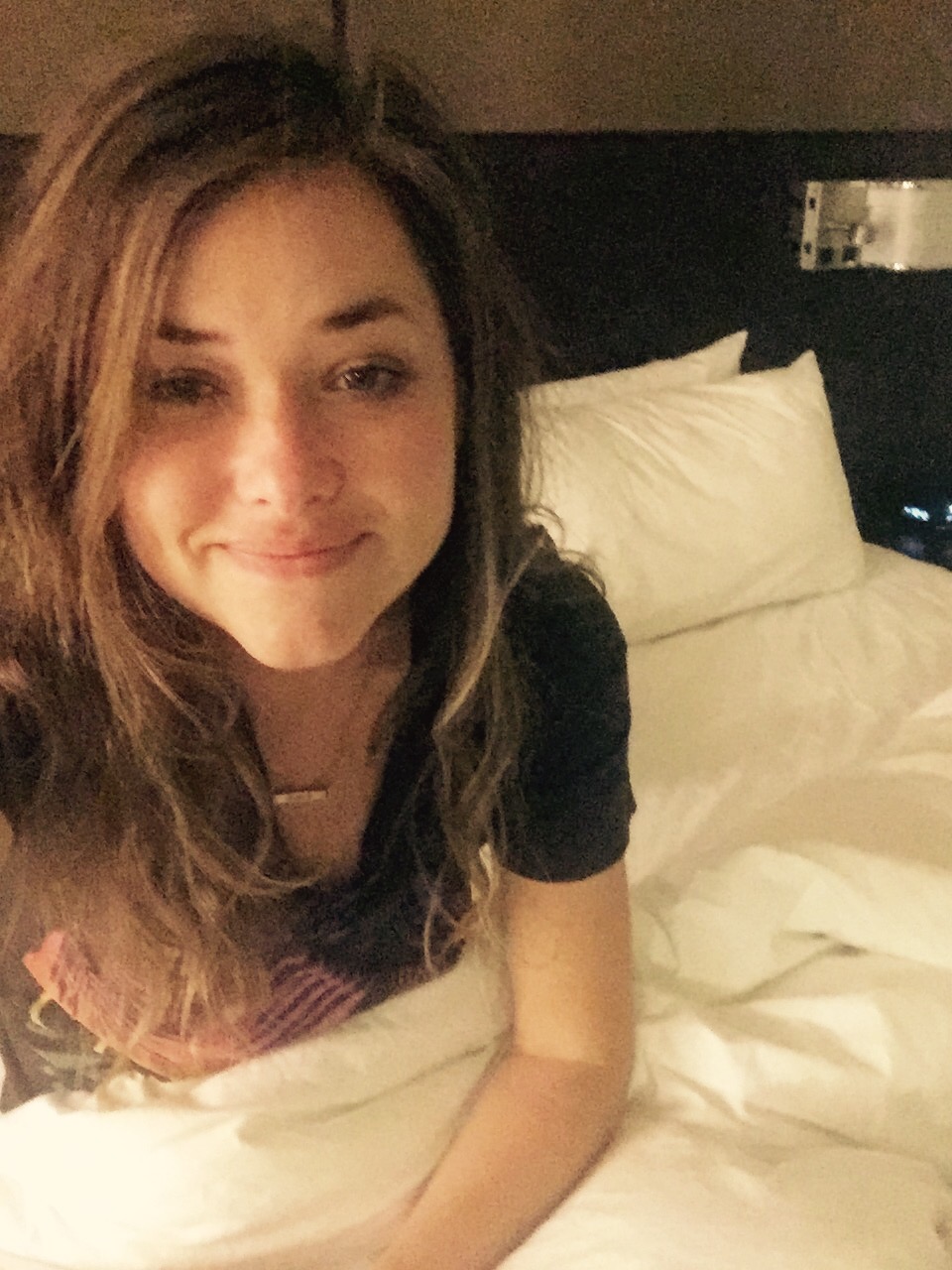
Getting here was a last minute near disaster. I was that last person jerkoff to board the airplane, out of breath from running. Then …I apologetically made the entire airplane smell like bengay because it was the only thing helping with my head and face pain which have been on fire all day. After the second application and an onslaught of coughing from a few rows back, I was nearly certain that this sort of coughing hadn’t occurred prior to Ben Ben time, so I knew I had to slow my roll. That stuff can be intense. Anyway, here I am. So tired and heavy I could collapse. And I did. I did that thing where you open the door and drop all of your things and small items like lipstick and pens go rolling out of your purse and you just lay there in a hard, thudded silence, face down in a bath of white linen. Also, the fact that it was a big king sized bed, which is totally unnecessary for me but awaiting my laying in it, made it feel all so luxurious.

King Size.

I’m still in that phase where hotels are a novelty and every part of them is fun. I imagine this is how flying on airplanes started out for most of us. But now it’s like this exhaustive, painstaking process. Gotta work on that. Anyway I was almost too tired to put on Jammie’s. But I did of course; I’m not an animal.

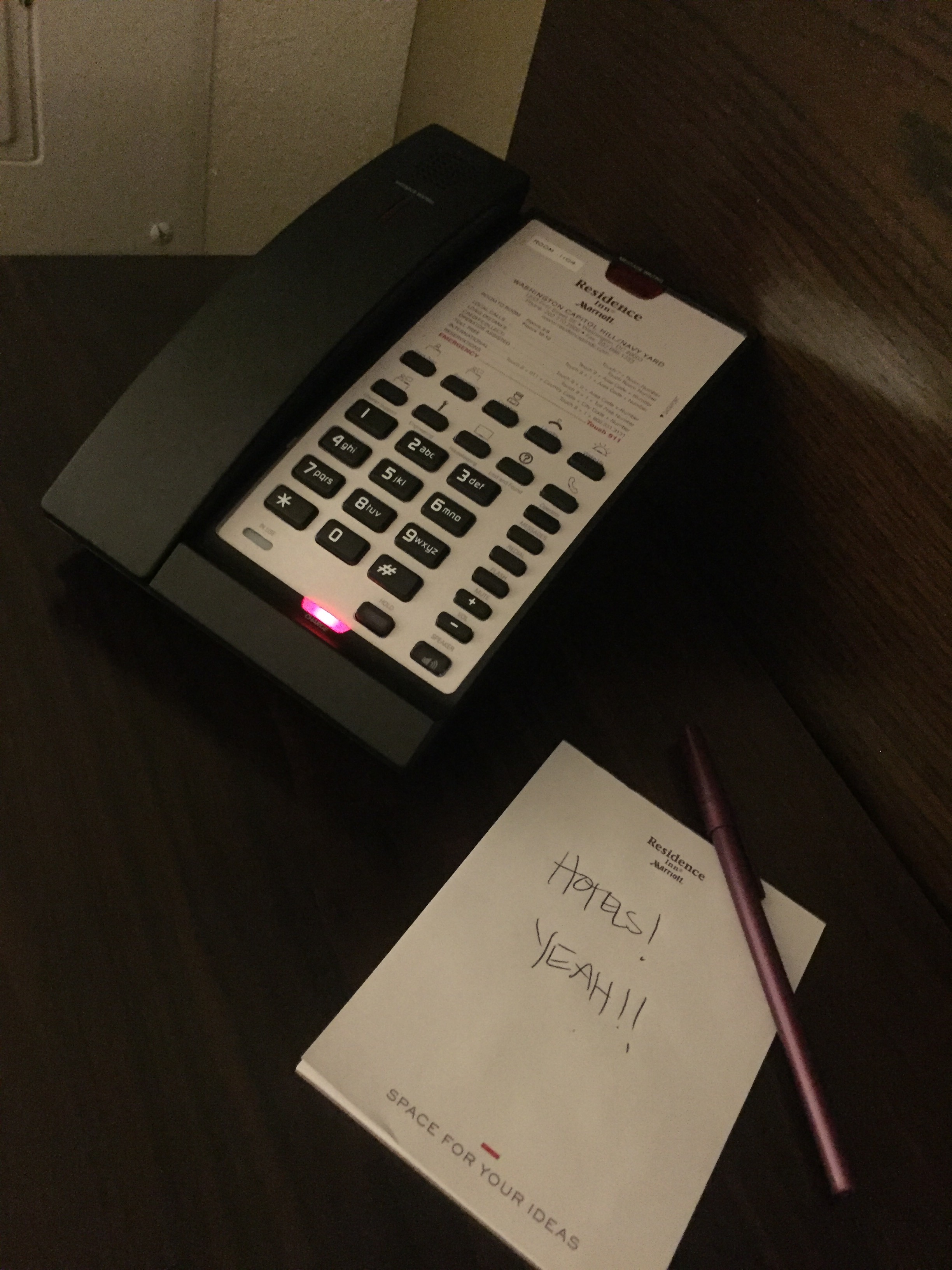
You just have to love hotel room culture, right? I just called the front desk and requested a wake up call. They said it was their pleasure. How nice are they! The cab driver asked me why I was here as we zipped around new territory and I took it all in through the backseat windows– beautiful place from what I could see. I decided to go for it, figured I need the practice anyway and the world needs to know. I said I was here to advocate for disease awareness and funding because it not only costs the country billions of dollars every year, it causes immeasurable suffering to millions around the world and right here in the US of A. After thirty years of inaction, its just time to make it right, ya know? (He didn’t say anything, but I went on. He at least pretended to listen) It’s been ignored and desperately needs adequate funding for research so we can treat and eventually cure it. And that’s basically it. There was a pause, then the rhythmic click of his blinker and a lane change, and another small pause.

“I pray for you. All of you who sick and all of you fighting!”

I wanted to hug him right then, but restrained myself and told him I really appreciated that, and I really did. We would take all we could get, I told him. And he said he’d pray hard. When he dropped me at the hotel, he told the bellhop “Hey! You take care of this young lady!!” The dude smiled and said “got it.” It all feels like some Netflix tv drama. Hard to explain. But really, really good to be here. It feels right.

It’s a long time coming having the chance to converse with people face to face, not through 140 word count snarky tweets with every kind of hashtag. I want to meet people involved in the system, shake their hand and look them in the eye. It will be nice to offer a name and a face with the disease, and tell the stories of people who are in desperate need but have been ignored for decades. For months I’ve craved a tactical human interaction where I could explore this subject, a connection where I could share the multitude of issues and see a reaction within another human being. And maybe, just maybe, we actually start achieving the solutions– which are just lying in wait for us, like some leftover suit at the dry cleaner. We don’t even have to brainstorm the solution, we know it! We just have to convince them we’re worth it.

I’ve longed to tell our stories out loud, beyond online. I am exhausted of twitter, I get down about Facebook, and clearly, I even abandoned this space a while. That’s another story. But the point is, Boots are on the ground, I’m ready to rumble and do what lobbyists do and talk about the multifaceted issues around mecfs preceded about talk of the weather and how crazy it must be to work in politics right now! (Cause like seriously, it must be crazy)

ORRRRRRRRRR I just lay down on the steps of the NIH all day because I’m too “malaised” to move.

The questions is, I think most personally for me, is WHAT ARE WE WAITING FOR? We know better now, so we should do better.  Oh shit, it’s 2 am. But I’m not worried, I got that wake up call all worked out.

I miss land lines.

In my mind I’m here for a simple reason–to help remind policy makers that this disease and those sick with it aren’t going anywhere. This will only get bigger, it will only get worse. The cost will become outrageous. Our options are basically zero in finding and treating this properly, so we’re leaving our fellow Americans in the dirt. Like my Uncle Tom says: “That don’t be right.”  There are so many things that need addressing and fixing, and if I consider them all I become easily defeated. But all of this has been a meditation in simply doing one thing at a time and doing it well. Doing exactly what’s in front of you.

So that’s how I’ll go about this trip. As clueless as I am, I trust in something deeper that helped bring me here, and I believe fully that we CAN fix this. We CAN do better. It’s just time to.. you know, pick up the pace. We’ve been in line at the DMV for thirty years– I think it’s time our number was called.

Will keep yall posted. Thank you for…..everything.

Health, Happiness, Battleground

Fuel to the Fire

It’s been so long since I’ve typed at a computer, I think my typing speed may have dropped to under 60 WPM. Dangit. I should probably quit writing everything by hand in notebooks, if I want the words to appear anywhere else but in a stack on my bookshelf, that is. Also my handwriting is pretty indecipherable so I guess it makes sense to stick to the computer. It’s just that writing by hand has always felt easier, more accessible and immediate. There’s something more rousing about putting actual pen to page. I hesitate less. My ‘thinking’ mind turns quieter, and the space that must open in order for the good writing to come through stays that way, without distraction. Especially when I’m scratching away with a really great pen. Right now it’s a black Pilot G-2 07. Sounds like a damned air o’plane, and I’d even describe it as a “smooth glider.”. So, I guess I’ll just be transcribing from page to machine for a while. I need an intern. Any takers? I will pay in doughnuts. Why is doughnuts spelled like that?

This last month has been filled with a few major milestones. Most of them aren’t mine, but in the absence of personal excitement, the achievements of those in my inner circle are close enough–plus it’s something to tell other people. Like someone will say Whats new Mary? And instead of saying Um, nothing. I say Not much, but my childhood best friend had a baby! See how that works?

My childhood best friend had a baby. For real! It’s still hard for me to wrap my head around it, not because she’s the first of my friends to start a family. But because we’ve just been friends for so long, since we were babies in fact. We still laugh at jokes from when we were five! Sometimes I feel so young around her–I guess the kid in me comes out. Now she has one! A beautiful, alert, amazing little daughter. It’s all very exciting. I’ve decided that I’d like her to call me “Ont Viv” (what Will called his aunt in the Fresh Prince of Bel-Aire) I find it fitting, and if she has half the sense of humor of her mom, she will appreciate the spirit of this name. Of course, just like a milestone birthday, this big thing happened, and yet it’s not that different. Kaitlin and I are still the laughing, weird, sister-friends we’ve always been, except now there is a tiny little girl sleeping in the corner while we talk. Funny how everything changes, but the middle stays the same. Welcome to the world Bernadette Jane! Love, Ont Viv.

My other best friend, Dr. Emils, got married a week later. I was a bridesmaid: score! A Southern girl and a guy from Amsterdam equaled a classic New Orleans wedding with a dash of Dutch. Nice. Two days of wedding festivities and a crawfish boil led up to the ceremony at sunset, on probably the best day of weather New Orleans has had all year. Everything was perfect and she made such a beaming, beautiful bride. It was a happy, lively experience to be a part of and filled with a lot of love. All topped off with a long second-line led by a classic Nola brass band singing all the greats, including When the Saints Go Marching In. Weddings are the best. No, New Orleans weddings are the best. If you ever get the chance, go! I’m really happy for my friend, mostly because I could tell how incredibly happy they were together.

I’m also the last single girl on the planet. Sweet.

Engaging in a two day wedding weekend is a rare chance for me to see old friends, to be around people my age, to have a reason to dress up–or get dressed at all, for that matter. It’s not often that I get to do things like this. Not often I get to be 32. My life consists of a lot of solitude, which I like, but it’s always nice to get a glimpse of life outside the farm. If anything I live more like a 90-year-old dog lady, so I try to soak up every moment of acting 32. It’s tricky too, because I know that participating in things like this are not without consequence. Acting my own age comes with a price tag, so every time I decide to do it, I’m making a silent agreement. No one really knows the gravity of decisions like this. Or what’s involved in just showing up, or how  I’ll pay for it all later. The choice is so much more encompassing than just deciding to attend a party. I swear I don’t write this out of some martyr, woe-is-me mentality. It just struck me as I was swiping through photos of the big day, which was a really fun day–that it makes perfect sense why so many people misunderstand the illness. They don’t know the weight and preparation and consequence of partaking in something normal, like being a bridesmaid in a wedding. How could they? All they see is this:

unnamed
I did.

They couldn’t know how much time and tedious planning went on beforehand, including scheduling when I would bathe, to ensure there’d be enough time for rest between that and the next event. They couldn’t feel the certain amount of pain you just have to bare through things like this. They don’t see the plethora of medicine necessary to endure standing and socializing and lasting through a night. And they’d probably never consider such things, like a bath, or socializing, as exertion in the first place–As something that counts against you in your fight to keep strain at an absolute minimum. And that is almost always the goal. It’s obnoxious even to me, as I write it now. The strange reality of living with this thing. The exhaustive necessities involved in even small things. You’re always calculating how much every little thing will cost you, always trying to save up if you’ve got somewhere to be. But what really struck me is that nobody sees what the pricetag actually looks like. That’s because the pricetag comes later. They don’t see the subsequent week or weeks of recovery that follows at home. Which can look a little like this…

waiting
Poor Monty

When I thought about the outward appearance of illness, the timeline of how it plays out, what I show to people when I’m out and what goes on at home–I realized not only how easy it would be to get the wrong idea about the disease, but also how I might play a part in misrepresenting its reality.

For one thing, I want to emphasize that the reason I am able to even show up and participate in a wedding is because I’m currently at a functional-enough level to pull it off. There is a spectrum to the disease, there is waxing and waning, and there have certainly been times throughout the last 6 years when I wouldn’t have been able to stand at the alter. Even so, being “functional-enough” still means tedious logistical preparation, and a two-week long crash as a result. So, I’m still miles from where I once was, or should be. But many others are bound to their homes, many are bound to their beds, and we are all suffering with the same disease. I realize that people may see me when I’m in public and just not “buy” that I could be sick. And I see why this misperception persists.

But I also think that often we assign too much power to labels, and we attach our personal version or image of what “sick” should look like, and those who don’t fit the bill are either doubted, ignored, or assumed sick “in their heads.” We should all consider the many forms that ‘sick’ takes, and acknowledge that even terminally or chronically sick people don’t look sick at all times. No one would’ve guessed my dad had cancer, and that guy was dying! Looks are deceiving, and this immediate tendency to mistrust what we don’t immediately see or understand results in a basic lack of humanity. I am probably at my most functional that I’ve been since 2012, but I still walk a very fine line. It can and does go south easily, and it still requires help from my parents, a lot of rest and recovery time, a ton of medicine and doctors, and a lot of supine time on my own. (With Monty) And I am a lucky one, for sure. I know that people who suffer with anxiety/depression, bipolar disorder, OCD, Lyme, MS, Lupus and other chronic diseases suffer with similar outer doubt and confusion because their illnesses are not always easily seen from the outside. Labels, symbols, projections; they’re all powerful things, and they’re something we should consider and adjust on the whole before we make up our minds about something we may know zilch about.

I think I feel the need to write about this because ever since I entered the world of MECFS advocacy last year, I came face-to-face with just how poorly understood the disease is, how much misinformation/pure fallacy is out there and dominating the conversation, and how many people are getting it wrong because of the name alone. (Another thing I understand, it’s a stupid stupid stupid name.) I also have to consider whether I am helping to change and fix these misperceptions or if I’m at all contributing to them; and if I am, what I can do to fix it. I thought a lot about that after the wedding while looking through such beautiful pictures from the day, from the confines of my bed, knowing I wouldn’t leave home for a while. I didn’t think critically about this before last year, but I’ve learned up-close how much these things matter. The problem of disbelief is so much larger than gossip or personal dramas. This is literally public opinion shaping policy. It’s allowing the lack of intervention on a disease affecting millions of our own and many millions more around the world. How long will we allow people to suffer? How long will we let the accountable people look the other way? The world is looking at us and our treatment of this disease, and we are totally blowing it.

As soon as we show serious interest, I know other countries will follow suit. I know we will also make important new discoveries and possible cures. For now, we are at a stalemate that is costing millions of lives and billions of dollars. It’s almost hard to believe it’s true or possible after so long. And yet, here we are…

In the last year there has been awesome and much needed support from the public. The many signatures on the petition was surprising and still continues to humble me. I should say, it was that petition with such a substantial amount of sigantures that scored me the local news spot, a meeting with the Louisiana State Director (whom I spoke with for more than two hours about mecfs) and the reason I had a follow-up with our Senator Bill Cassidy. There’s more on the horizon. I’ll write more of that later. But our fight to be recognized, pursued and funded for biomedical research has come closer than ever in the past year, and we have to keep up the momentum. To quote my mom, “The timing could not be worse.” Hah, she is right. Politically things are somewhat of a shit-storm right now, and the potential for a slashed NIH budget on the whole obviously doesn’t work in our favor. But with the recent diagnosis of my sister, the possibility of backtracking our earned success, I have a renewed fire to fight and faith in myself, the advocates, the public, and the system, and an unrelenting hope that we can and will fix this. The timing might be terrible, and yet the truth is, there’s no better time for change than right now.

There are so many people in the advocacy arena who are doing big things–as for me I will continue to campaign for awareness in all ways I can think of, and restart petitioning for signatures. But I think possibly the most powerful voice is that of the public– not from those who are sick, but from those simply who see the injustice that’s happening. That’s who we need to hear more from, and seeing the amount of healthy people who have signed the petition already restores my faith in people all over the world will come together and make this happen. Thank you all again. Here’s to the next 40,000…

Health, Happiness, Fire

Let the Spider Live

When the phone rang I was in the kitchen, boiling a potful of spaghetti and whistling along with an FM broadcast of the overture to Rossini’s The Thieving Magpie, which has to be the perfect music for cooking pasta.

wind-up-bird-chronicleIs this not the most perfect first sentence for a novel you’ve ever read? It reads to me like poetry. It’s the first line from The Wind Up Bird Chronicle by Haruki Murikami, a novel I’ve been hypnotized by for over a month now. I finished it yesterday and I have that accomplished but sad void inside where the book used to live. It was a colossal novel and could have gone on for a thousand more pages, and I’d be happy to read them. The Wind Up Bird came after a similarly mesmerizing experience reading two of his other novels: A Wild Sheep Chase and Kafka of the Shore. I couldn’t say which I love the most–they’re all my favorite. Suffice it to say, Murikami is my favorite new author, and I’m a little late to the game. Luckily for me, he is a such a prolific writer with a large repertoire to choose from, and I just can’t see transitioning to a new authors work right now. I’m glued to his clean, composed writing, rock solid metaphors, and uncharted territory in terms of subject matter, truly. Read any one of the aforementioned and you’ll know what I mean. Transitioning to a new author now would be like shopping at Armani your whole life and then being thrust into a jam-packed Forever 21 store with flashing lights and blaring electronic house music. I just have to stick with him for now.

I can’t sleep again. It’s 4 am and I’ve been up and down all night. Actually it’s been more back and forth: bedroom kitchen, bedroom kitchen, microwave heat pad, kitchen bedroom. My bones are achy all over, the flu-type of aches, except that it’s explicitly in my bones and not muscles. Don’t ask how I know that for sure, but I do. There’s nerve pain, muscle pain, and bone pain. This time it’s the bones. When I rustle the sheets to get out of bed, Monty’s head jerks up to watch me, calculating whether he should get up to follow. But when I hold up the heat pack in my hands, he knows I’ll be back in one minute and thirty seconds, or something close to it. His heavy head plops down, he stretches all four legs and takes a deep breath, then drifts away. There’s something calming about Monty sleep on the edge of my bed, his belly rising and falling. It’s also nice knowing he’ll save me from my nightmares when I’m stuck in one and can’t wake myself up. I envy how perfectly in sync his body is with nature. The rhythms are so obvious. Always asleep by 10:00 pm, awake around 8 to go outside, and pawing at the pantry door at 6:30, ready for dinner. My body’s internal clock has been broken for years, so it’s nice to see one that actually works. I wonder what he’s dreaming of now. He’s chasing something fast because his legs are kicking away and he’s making small whines and growls. Probably a squirrel.

Sometimes I take insomnia as not a symptom or interruption, but a sign that I should probably just wake up. So here I am, here it is.

There is a large black spider that I noticed out of the corner of my eye when I was reading earlier.  In my peripheral I noticed something dark making those jagged, stop-go movements along the wall. By it’s jerky advance I figured it was a spider, but I was not expecting the huge size of the thing. The circumference a tad bigger than a mardi-gras debloon. It’s not long legs that get to me, but when they have a thick body- forgetaboutit. This one did, and every time I looked his way he stopped dead in his tracks. I tried to catch him anyway to let him outside, but to no avail, so we’re just hanging out I guess. He can’t make up his mind about staying or leaving my room, but when I intervene and herd him like a sheep in the direction of the door, he splits and goes the other way. Owell. I’ve become pretty desensitized to arachnids, insects and even vermin since moving back to “the farm.” We get a lot of Wolf Spiders here, which look exactly how they sound–frighteningly huge with thick hairy legs. They are abundant but not poisonous. Sometimes I see Monty pounce to a corner of the room and I know that’s what he’s after. For whatever reason, maybe it’s the statue of St. Francis in the garden, I feel the need to save every animal I come across in this house. Same goes for the pool. Sometimes this means taking a substantial amount of time just to save some critter, which I’d imagine many people would call a damned waste of time. And maybe they’d be right. But the mouse would beg to differ.

Once, I was trying to save a small frog in the pool who was being a real jerk about it. He kept jutting to opposite corners every time I went to swoop him up. Finally he was sucked into one of the skimmers on the side and I was able to scoop him out. When I looked in at all the other debris and leaves swirling around in the basket, I saw a large spider struggling to stick to the side. If I put the lid back on top he would obviously die in there. I squatted there in the sun watching a while, and it occurred to me Why the frog but not the spider? I reached in and scooped him out too. Ever since, I save all the animals around here that I’m able, and there are a lot and of every variety. Last summer it was a rather large blue skink–not easy. But I just can’t see where we should draw a line on who stays and who goes. I find it funny when I hear that bears or deer are “encroaching on our land!” Wasn’t it always their land, or just land where they hung out, until we decided to develop and build on it, driving them further and further out until there was no place left to go? I don’t mean to be some PETA extremist throwing paint on our growth. It just seems like the earth is a large enough place that we should be able to live in tandem with creatures who came far before we did without pushing them to the edge. “Population control” means lots of dead animals. And I understand the premise, the intention. I don’t know, maybe I’m too romantic and that’s a Utopia that just isn’t possible.

One morning while brushing my teeth, I kept hearing strange high pitched squeaks. At first I thought it was the AC unit or some indoor appliance. But then I saw Monty heard it too, and was sniffing all around with his tail and ears rigid and alert. He sniffed the ground until he got to the bathtub and stopped. I heard the squeaks again, and like a scene out of a Hitchcock movie, I slooowly peeled back the shower curtain, when suddenly a mouse squeaked and bolted, running for his life in circles around the tub. Like any civil woman, I shouted loudly and needlessly, while Monty tried to lunge inside the tub to capture it, I guess. Once I collected myself, pulled Monty away, I saw that it was just a baby mouse. We all came to a hault, and I could see his poor tiny heart thumping. Finally I found a gladware container, that’s basically all they’re used for at this house, slowly ushered him in and let him free outside. He quickly disappeared underneath the leaves and Monty sniffed at the spot for a while. I have so much uninterrupted time for these kinds of things, and I think that’s why they happen. If I were a busy woman late to work, maybe I’d have a husband and maybe he’d have killed the mouse and we’d have gone on with our lives. Funny how differently things can turn out.

Now I cannot see the spider, which I think is actually scarier than seeing the spider, because who knows? I keep jerking around suddenly when I feel an itch or some movement, but it’s mostly just my mind freaking me out. Hopefully he’s gone to the hallway bathroom–that’s where most of them end up.

Anyway, nights like these are not infrequent for me. I am often up at strange hours, and years ago I realized how sacred the night had become to my life. It felt like this whole other private world. No questions, no explanations and defenses, no phone. The walls come down, and a lot of ideas come to me then, sometimes annoyingly when I’m really tired, but they’re incessant and poke at me, so I keep a notebook next to the bed. After I write them down my mind settles. Sometimes they’re poems, dreams, letters, randomly long essays, and sometimes they’re just a one line sentence that is begging to be written. Recently they’re rhyming poems, which normally I hate. But strike when the irons hot, I guess. I think that most of my poems are crappy, but I find when I keep at a few of them for long enough, sometimes weeks– a little work everyday– I might end up with two or three stanzas that I would call decent bordering on good. I’m not sure, there’s really no way to gauge your own work.

You’re doing it again
You’re talking to yourself
I said that I wouldn’t
But there is no one else
Whom else could I speak
Without opening my mouth?

You’re wise enough to know now
there’s two of us inside
a sick one who is fading
and a strong one that won’t die
the reflection in the mirror
is a face, and not a mind
don’t let that pretty shadow you,
think that’s where to find
the one that wakes you from the dream
the one that comes out alive
one of us lives by numbers
one of us doesn’t tell time

There’s something you said,
And you weren’t wrong.
Things get weird
Alone too long

the question is
who’s writing this
the writer or the wrong

That’s a snidbit from my “No I’m Not Talking to Myself” series. Don’t worry, it’s not meant to be sad and I hope it doesn’t come off that way. But maybe it does, like I said, I need a teacher. I know they’re just basic rhymes and they lack some of the mystery and depth that great poetry contains. But I’ll keep at it and add the rest to my poetry page. Haters can leave comments there. It’s cool, I can take it.

I should try to sleep now. I’ve written way too much and I just transferred half of this post to a document on my computer that will probably never get read. My mind is so scattered lately, I have to get organized, but it’s been unusually hard. I guess I’ll start with sleep. That’s an OK place to start.

I’ll leave you with my favorite lines from The Wind Up Bird Chronicles. I can’t recommend Murakami enough, and I’ll write more on him next time. It has been a supernatural experience reading his books. Really.

“What gave money its true meaning was its dark-night namelessness, its breathtaking interchangeability.” 

“Once he got a taste of the world of mass media, though, you could almost see him licking his chops. He was good. If anything, he seemed more relaxed in front of the cameras than in the real world.” 

“..We never saw each other again. The relief this gave me bordered on ecstasy. Nothing so consumes a person as meaningless exertion.” 

“When your hair starts to thin, it must feel as if your life is being worn away..as if you’ve taken a giant step in the direction of death, the last Big Consumption.”

“Everything was intertwined, with the complexity of a three-dimensional puzzle- a puzzle in which truth was not necessarily fact and fact not necessarily true.” 

“I guess time doesn’t flow in order does it–A, B, C, D? It just sort of goes where it feels like going.”

Oh, I see the spider. He’s in the corner and positioned on his way out. Maybe I’ll save him in a glad-ware container tomorrow. For now I feel like I’m going to ralph. Good night.

Health, Happiness, Arachnisomnia

Cheers To a Slowly Dying Christmas Tree and the Start of Something New

My Christmas tree is still up. We might start there..

Two Fun Facts. Even when your Christmas tree begins to shrivel and sadly die in the corner of your living room:
1. The decorative lights still emit that magical glow when turned on at night and you’d never know their was death lurking behind them.
2. It still smells like Christmas! Even while dying, that one of a kind sap-infused, woodsy, cinnamon smell still infuses the room from the corner where the tree sits, but looks more like it’s floating.

I still catch random whiffs of Christmas when walking by or while reading on the couch. It’s like the original air-freshener, and since the scent is so sporadic and only comes around once a year, like Girl Scout cookies, encountering it feels uniquely special. Like glimpsing a shooting star or seeing a bald eagle. Sometime its feels like a nice gift the tree is sending my way. I think, Hey thanks tree, you have a good day too! What I’m saying is, you begin to talk to things that are not human when you live alone, and that’s OK. It’s bound to happen. I think. I’ll ask Monty.

I tried deciding whether a Christmas tree still hanging around on January 22nd that also happens to be dying is depressing conceptually or not. I say conceptually because I can say from an actual standpoint, it most definitely is not. It still brings all the joy it did from day one. I am a Christmas enthusiast and my fervor has always extended to the art of holiday decor and the unmistakable enchantment of a Real Live Christmas Tree. Everything about them makes me happy. Until I start seeing them on the corner of peoples driveways laying on their side next to the trash can– what a tragically depressing image to encounter. Or it always was for me, growing up. I feel that keeping the tree around this long and seeing it to its final days, I’m squeezing every ounce of wander out of what Christmas trees have to offer. It’s like The Giving Tree! Except in this case at the end, we burn it in a large pile of leaves and miscellaneous dead foliage and branches out in the prairie. But I find this to be a far less sad ending to the tree than awaiting its demise on a driveway and being tossed in a trash truck full of rotting food and discarded junk. I wonder if it freshens up the smell of the garbage truck? Probably not. Anyway burning the tree returns it to where it came, and whether that works out scientifically or not, for me it feels like a much kinder fate. And symbolically more appropriate.

As for outsiders, seeing a dying Christmas tree still lit up in my living room might look like a lapse in civility or domestication on my part– some kind of improper etiquette. Like having dishes in the sink or a mess of a house when company shows up. It’s always a little shameful when people visit, especially unexpectedly, and your place isnt tidy. Somehow it feels like a reflection of you– whether clean or dirty, we’ve come to see dishes in the sink as a little pitiful and a perfectly sanitary house as the height of a life in order! But order doesn’t imply anything moral or productive. Then again, a really dirty house does start to make you wonder about the direction someones life is going. If you haven’t done laundry to dishes in over three months, it might be time to talk to someone. It’s funny how having a clean house gives us a sense of pride and sends the message of “I’ve got my shit together and things are great!” Somewhere deep down, don’t we all secretly wish our homes smelled faintly of Pier One Imports? THAT is a fresh, successful smell if there ever were one. Unfortunately you can’t detect what your own house smells like, you can’t discern your own smell, so you kindof just have to keep up with the cleaning, pray that your pheromones mix well with your dish soap and the wood of your cabinetry and whatever else is informing the air of your house, and hope for the best. Many houses I can think of from growing up have distinct smells to them, that are still there when I visit today. It always elicits memories of certain times way back when. Funny how just a smell can be so tightly tied to a person or experience. I can still remember the exact smell of my grandma baking homemade bread. It takes me right back to childhood, to punching down the raised dough in those huge seventies-colored bowls, and to that first piece warm out of the oven. Son of a nutcracker I am hungry now.

Anyway, I imagine somewhere in a book of manners and proper social behavior, there is a responsible cutoff date for the Christmas tree, and if yours is up past that date, forget it. You might as well quit your job and stop tying. For me I don’t have a real job so there’s a personal loophole–if in fact, Jan. 23rd is past the cutoff date for tossing out the tree. Anything after that is an obvious decay of domestication. Or maybe just poor manners.  Maybe I’m still in the clear because it’s still within 30 days of Christmas, and if I can still technically return a gift to Target, then I should be squared away with the tree. Either way, none of this actually matters and obviously you should keep your tree up as long as it makes you happy and does not accrue mold. Isn’t that how we justify killing them for the purpose of holiday decoration in the first place? By enjoying and appreciating their beauty and assorted pleasures for as long as possible, we sort of redeem cutting them down. Sort of. I don’t know, what is the environmentalist take on real Christmas trees? Is real or fake the greener choice? Probably fake, right? Let me check.

Well that was a hellstorm. I’ll save you some googling time and just say the conclusion to ten articles on this very subject is that the science is still out on conclusively naming one or the other as better (or worse) environmentally. Worth noting is that artificial trees are created using this special ingredient calling PVC (polyvinyl chloride) which is not recyclable nor completely biodegradable. Also vinyl-chloride is listed as a human carcinogen. You have to use the artificial tree anywhere from 7-20 years (there are multiple conflicting studies)  in order to make it less harmful to the environment than using a real Christmas tree. Also at least 90% of real Christmas trees are farmed, which keeps the natural population healthily sustained. Hmm, one can emit hazardous fumes in too high a dose, and one provides magical Christmas dust that enlivens the senses and makes miracles. So I am biased clearly, but I still say down with artificial arbor. Go real. Go green. And inhale that magical smell until March if you want to.

Its funny, but even though Christmas is well over, I’m still recovering from the festivities I partook in. Some of it is my fault; I have a hard time doing what’s best for myself in terms of the illness, and doing what is fun and adventurous and happy in the moment. This disease is so insidious, it doesn’t let you know how much you’ll have to pay until you’ve already done the damage. Its like going swimming today, but not having to hold your breath until tomorrow. Say you swim in the ocean and get distracted by the tropical fish. You go under water following them around, and all the while you think “I haven’t been under that long, I’ll definitely be able to hold my breath this long tomorrow when the time comes.” You think that because you’re stupid and you didn’t learn your lesson from last time. The next day comes and you have to hold your breath for all the times you went under water, but on some of your sub-surface excursions, you were distracted by awesome sea life and stayed under like 3 minutes. Now you’re trying to hold your breath for three minute stints and you’re blue in the face and passing out and thinking, why did I go under the water. Why Mary WHY. So, that’s one way to explain it. Anyway, Christmas is happiness and this year it was a great one. Sometimes the dive is worth turning blue.

I’m not sure what it is exactly, but I’ve had the feeling for a while now that 2017 is going to be a very special year. I can’t say how specifically, but I sense that big changes are in store. Important changes. Great changes. And that the start of something new and big has already begun its course. It’s only an intuition so what do I know. Maybe anything compared to the dismal 2016 will seem auspicious by default. But something tells me it will be more than that.

I never saw myself in the world of advocacy or politics, but tomorrow is the first day of a very important journey that I suppose will include both. It’s the first time I will meet with a politician to talk about me/cfs and address the funding issue, in person. I’m meeting with the Louisiana state director, Brian McNabb, who works in the office of Senator Bill Cassidy. I have no idea how the meeting will go. Of course, I have my talking points prepared and there is only so much my brain can store. My main is goal is to tell the truth and leave a lasting impact. In my imagination the scenario goes like this:

We start with some charming banter yada yada yada, he pours two glasses of whiskey, and as the ice clinks in our glasses I say “Look McNabb, we need $100 million from the NIH for this disease. Minimum. And we need it yesterday.” He thinks a moment, sips his drink img_6334and says “You know, after reading the riveting history of this disease, the outright neglect, and the heartbreaking stories of so many who’ve been devastated by it, I’d like to offer $200 million toward biomedical research. It’s actually the more appropriate and fair amount.” I walk over, raise my glass to toast to this proposal and say “Wonderful Brian. You’re doing a really incredible thing.” Clink!

“How soon will the funding come through to the NIH?” He thinks a moment, “I’ll have to get a few documents in order, but I’d say by tomorrow around 4. Does that sound alright?” I begin to put on my jacket to leave. “Sounds fine.” He opens the door, “I’ll let Mr. Collins know about the funding change. Anything else?” Walking out I hesitate, stop, then turn around. “Actually, I have these parking tickets in New Orleans I never paid-” “Ms. Gelpi! Don’t be ridiculous! I’m not a genie I can’t just say ‘poof!’ and fix everything!” I blush from assuming something so stupid. “You’re right, I’m sorry. It was foolish to ask. Forgive me.” I turn my head away a little embarrassed. He nods affirmatively and ushers  me out. Before he closes the door I yell inside just to be sure “But we’re still on, $200 mil to the NIH tomorrow by 4? Right?” He already has a phone to his ear and looks distracted by some new matter. “Right. 200 mil. 4 o clock. G’bye now.” The door shuts and I turn to walk out, grabbing a handful of Worthers Original candies from the crystal bowl on the secretaries desk. She doesn’t mind. Outside it’s chilly as I walk to my car and my legs are already aching, but I don’t mind, it’s too happy an occasion. I arrive at my car and immediately notice a boot on the front tire because my meter expired while I was inside. There’s also a notice that says I have dozens of unpaid parking tickets and my car has been seized. I turn around and march back toward the tall marbly building. I dial my mom, walking up the steps. “Well?” she answers with anticipation. “Mom! I’ve got good and bad news, which would you like to hear first?”

The End

That sounds like a reasonable scenario, right? I’ve heard that’s how Washington works so, I’ll keep you posted. :)

Health, happiness, GREEN.

All I Want For Christmas is $100 Million Dollars

100 million dollars. I’ve never lived in a world where that figure represented an actual amount of money. I don’t think I’ve ever used it for anything more than hyperbolic effect in conversation. As in, Anthropologie is so expensive even a scarf there is like, 100 million dollars. I’m not even sure I could write out that number with confidence about how many zeros follow the number one. Unacquainted as I am, I’m learning to write and say it with total conviction, because now it does represent an actual amount of money, and I am seeking it with earnestness. Within the strange world of politics-meets-medicine, it’s no longer an absurd number. In this new context it’s become completely reasonable. In fact, some would say given the facts, it’s an exceptionally modest amount. Go figure.

As many of you are probably tired of reading about, I began a campaign earlier this year requesting that the NIH allocate this amount of funding toward the research of a mostly neglected, orphaned disease. Over the year, this has become the most important pursuit of my life. And I believe the cause to be one of the most important in anyones life: our health. Like many things, you don’t realize how important it is until you don’t have it anymore.  Stepping foot into the advocacy world provided me with a new, unexpected perspective–to see the community I’m a part of, from the outside in. This adjusted outlook has fueled my insistence for change to a degree I’ve never felt before. Interestingly enough, this outside viewpoint began within my own family, but not from my own experience with the disease.

I rarely talk or write about it, but my mom has lived with ME/CFS for two and a half decades. Most people with this disease will tell you there is a pre-sick version of themselves that couldn’t quite  survive once the illness took hold. I was only 2 when my mom became sick, so I don’t remember or know her as any other way than how she is. I’ve been reflecting on the reality that there is a whole side to her I’ve never really known. Prior to getting sick, she might better be described as a type-A personality. She was fast-moving, organized, sharp–an ER nurse. She and my dad had a large social circle and were both involved in the community and church. But no one would ever know about this past part of her, how could they? She left work tentatively to devote herself full-time to motherhood and raising four children under the age of five. In pictures she looks happy and privileged to be a mom and wife. In old videos she is lively and beaming, her voice animated, giggly at times.

unnamed-5
Real nice, Doug.

Christmas morning, 1984. 4:30 am. Grainy video footage taken mostly by my dad (a tech geek elated by new video recording technology) reveals this other side to my mom that many people besides me have never known. In the classic reddish-brown hue that tints all memorabilia from the 70‘s and the early 80’s, three kids under the age of five are glowing in wait in our sunken living room. The fourth kid, me, is five months old sitting in a car seat on the sofa. (Thanks guys) My siblings frantic excitement is palpable–the kind that only comes on Christmas from children who still believe. They remind me of shaken up cans of cola, overflowing with joy. In contrast my mom and dad aren’t entirely awake yet given the hour, and early video footage provides evidence of a boisterous Christmas Eve party late into the night before. They speak in soft tones of voices and have glazed over look on their faces. Despite the lack of sleep, my mom still looks beautiful in a long white robe, rubbing her eyes intermittently to try and pep up. The kids grow more intoxicated with each new gift, and both my parents take turns reacting to 3 individual shouts of “Look at my new toy! Look! Can you open this?” Crumpled up wrapping paper begins to litter the room like discarded wads of kleenex. Outside, it’s still dark.

one.jpg
Toy assembly line, 4:45 am
unnamed-1
My brother Nick is crying because he can’t find his legos.

I love this footage for many reasons. For one thing, it captures such an iconic display of Christmas morning during such a happy time as if out of a Rockwell painting. You can sense the love between my parents, and observe childhood traits in my siblings that still exist today. Nick is methodical and organized with his unwrapping, and with everything. At one point my sister Amelie opens a gift and says “Wowwww!!!”as her eyes grow huge with excitement. When she shows it to my mom she laughs and says “Amelie, this is just the box.” My brother Doug still receives high-tech gadgets for Christmas and maintains the same enthusiasm. And me, I am still perfectly content to lie on the couch surrounded by my siblings–listen to them tell stories, laugh, bicker, cook, play games, and pine for my mothers attention. Even as a baby, I was comfortable and entertained just watching and listening to them live around me.

unnamed-3
Christmas Eve, 1984

The footage is also deeply nostalgic of course. It’s both wonderful and emotional to hear my dads voice again, to see him alive and in his element. Happy, goofy, making corny jokes. But it’s also a snapshot of the woman my mom was before she got sick. It’s not that this part of her is totally gone, but the illness simply changes your capacity for regular things, even socializing. As such you’re forced to make adjustments. She appears so spirited and vivid in these videos, so unweighed down. Maybe it’s because I so often see how the illness has effected my own appearance every time I look in the mirror, my posture, my facial expression even, that I can easily spot how it’s changed her physically, her whole body language, the inflections of her voice. Even sleepy and in the early hours of morning, there’s an underlying, unrestricted vigor in her–something that lies dormant now. There is a heaviness to this disease, like an invisible ton of bricks you carry with you at all times. Look hard enough and it’s not so hard to see.

My mom was never able to go back to ER nursing as planned. “I couldn’t trust my brain anymore” she says, and the stakes in that line of work were just too high. While she still calls so many people friends and loves them the same, her social life took an extremely hard hit. Given the insidious nature of this disease, I imagine it’s difficult for those who knew her before she was sick to adjust to this comparatively different, limited person–who by most accounts appears so much the same. As a result, relationships struggle to sustain the blow dealt by all the change, and to continuously explain the illness and your newfound incapabilities is exhausting, especially because you have such little energy to begin with. As a result, many people tire out and turn inward, ending up more like hermits or monks. My mom has always been strong and independent, never one to feel sorry for herself or even reach out for help, perhaps sometimes when she could use it. As much as she’s made the best of it and adapted to a less social life, I know a place in her aches not just for the friendships she had, but for the friend she was once capable of being. This is one of the hardest adjustments to the illness, particularly painful because it happens during a time when you need friends and support the most.

Since the birth of her second child, my sisters health has been steadily declining. For the past year and half she has slowly worsened with classic MECFS symptoms. Ruling out many other diseases that mimic this one, she will see a specialist soon for an official diagnosis. But many tests are showing the same abnormalities as those with ME. She is the same age that my mom was when she got sick.  Fortunately because we know now the best course of action, she has a better chance of recovery by addressing it early and aggressively. In March, she left her job tentatively to attend to her health full-time and attempt to get her symptoms under control. She has seen what pushing it has done to both my mom and me, and I don’t think any of us could stand it if it happened to her too. I know leaving her job was not easy for her. She loved her career as an interior designer, began a successful start-up firm with a partner and worked extremely hard. But as her symptoms became more frequent, more severe, longer and harder to recover from, she knew she had a decision to make: Cut her losses now or risk losing a lot more later on. She chose to act now, which was no doubt the right way to go, but I doubt that made the decision any easier on her.

For so long, my whole family, especially my sister and my mom have been my champions who carried me when I was weak and encouraged me when I felt hopeless. I’m so eternally grateful to them for all they’ve done and continue to do, and I’ve always wondered how I will ever repay them and my whole family for their kindness. I believe now it’s my turn to be their champions. Maybe this is my chance to finally return the favor.

I don’t have money to pay back the expenses, and I don’t have the strength to reimburse them by “working off” my debt. What I do have is a voice. A small platform. And a petition with 40,000 signatures. I’ve watched what this illness has done to my family. I’ve read the hundreds of heartbreaking stories that sick people have left on the petition page or emailed to me. I’ve become friends with Jamison Hill, the first person I’ve met who’s close to my age and has MECFS. He was a former personal trainer, and has now been bedridden since January of 2015. He lives in a dark room, able to tolerate exceptionally little light and sound; most days he is barely able to talk. Seeing this widespread devastation was upsetting but also opened my eyes to the urgency and dire need of this issue. It lit a fire within me that’s stronger and different than before. I think sometimes it’s easier to fight for other people than it is yourself.

My mom and sister never gave up on me, and so I promise that I won’t give up on this. It’s a black and white petition with a very specific ask. I won’t settle for the gray bureaucracy of political red-tape that is slow moving, inefficient and has failed this community for the last 30 years. I am hoping Santa, or the right senator, can bypass all that.

What an amazing Christmas it could be for millions of people with this disease around the world, to finally have real hope knowing that change is happening now, and the kind of research we’ve all been waiting on will finally be possible. It’s not a change that would normally happen quickly. And I don’t expect this fight to be easy or painless. But, it is Christmas. And even at 32, I still believe in something powerful around this time of year that makes anything possible. I know that this is, but it will require the right kind of help. Here’s hoping, for all of us, that we get it.

Health, Happiness, Believe

If you’d like to add your voice or help circulate the petition to more people, that would be amazing and please click here.

To donate to Jamison Hill’s medical fund click the link!

Yall Rock, Thank you to all.

Tension of the Opposites

I often forget that my life is somewhat unconventional– That it requires further explanation to obvious meet-and-greet questions. I forget that answering the typical questions that arise with meeting someone new or catching up with someone old will often start a domino conversation effect that can go any number of ways. Sometimes it’s unintentionally critical questions, sometimes it’s the strangest of medical advice, and other times it’s this awful but easy-to-spot look that no matter what words they’re saying, it’s only the word doubt that’s written all over their face. Of course they’re not all this way, and sometimes when I let down my guard and am honest about my circumstances, it opens the door to friendships and closeness I would never have expected. There’s something about sharing a hardship (without being overly needy) and being heard openly, that evokes a certain trust between two people. It says I have seen the darkness too, and the space between them lessens.

There’s a whole spectrum of reactions, and even though I forget temporarily, for the most part I’ve grown used to and so prepare myself for the array of conversational tones and and twists and turns our exchange may take. It took a while but by now I can usually see where things are going fairly quickly and attempt to steer a conversation going nowhere either back to the other persons life or to an entirely new subject altogether. It’s for the best. Outside of the new and complicated, sometimes awkward anecdotes that come with simply talking to a person, my life feels very normal. On a personal, day-to-day level, I’ve grown used to the terms by which I live, and it’s usually when I share these terms with someone else, my large set of footnotes, that I remember how not normal my situation is. I long for the day when I can complain about my jerk boss, commiserate about the insane landlord of my apartment, (which in my fantasy always has big windows) and when my roommates are no longer my parents. No offense to them–they no doubt long for that day, too.

Living life with a chronic illness means a few things for me: It means being 32 and not working a real job. It means taking 25ish pills a day and still living under my parents wing. It means a lot of solitude and a lot of talking to the dog–probably more than to humans. It means I typically smell like BenGay or peppermint oil, and wear an ice pack on my head almost always. These things have aligned themselves under my own heading of conventional. They are my normal. But I forget that they’re not and require an often long, boring story that explains “my normal” that I’ve grown to cringe whenever I have to tell it. Reciting how and why you arrived at here and now, over and over and over out loud, you almost start to feel like a phony. I don’t know what it is, except that maybe after so long of recounting a story, one that could easily be labeled as unfortunate, in such a casual tone of voice that’s inarguably bored with itself, you begin to question how it is that you’re happy. How it is that you consider such ridiculous conditions as if they were commonplace and acceptable. You start to wonder why you aren’t more up in arms about the whole thing.

I don’t know when it became such a frequent place to end up, but lately I always find myself hanging in the tension between two opposites, struggling to find the fragile balance in the middle. Feeling bide between two of anything is usually unsettling at best, but can often (for me) be exhaustive torture. The two forces aren’t necessarily always polar opposites. Sometimes they’re merely dissimilar, but operate on the same plane. Think surrender and giving up. Gone unchecked, one can quietly ooze into the other, and suddenly you’re nowhere you ever meant to be. Sometimes they’re contradictory forces: maybe your heart wants something that the head doesn’t like. Other times it’s reconciling two truths at odds, choosing between two options and stuck in the messy mud of the middle. Since I consider myself pathologically plagued by indecisiveness, I seem to find myself living in this “tension between two” all the time. It’s trickled its way down from me flailing between two important choices, to agonizing over things as inconsequential as toothpaste. I’ve spent way too many hours of my life struggling in that aisle.

Currently, I find myself in the center of multiple conundrums, questions, opportunities, examinations.. Not all of them are quantifiable, and many of them seem to be ongoing or recurring. I lay in bed at night and the questions fly around the room like some kind of adult mobile made of cosmic curiosities and pitiful choices. Here’s an example of the things my brain has been tangled up with lately:

*How do I surrender to my circumstances and accept my reality without giving up on trying to make things better?

*How do I talk about being sick without getting caught up in my story?

*How do I write bearing the reader in mind without compromising authenticity?

*How do I maintain a sense of autonomy and identity knowing full well I am reliant on the help of others.

*How do I engage in advocacy that is proactive and realistic without losing myself and my worth in every day outcomes?

How do I satisfy this sweet craving without overdosing on gummy vitamins?

Welcome to what Carl Jung called “The Tension Between the Opposites.”

Jung taught that if you can withstand the tension between two opposites, if you can sustain the angst of being suspended in the middle for longer than what is typically comfortable, often possibilities and solutions will arise you wouldn’t have considered before. It can be an enlightening experience, but not easy, and often painful while in the thick of it. The waiting is tough. But if you can hold that tension, you’ll usually encounter what he referred to as ‘The Transcendent Third’. This new ‘third’ solution can involve both or neither of the two pieces you’re between, but in the wait, you can reach deeper into consciousness, and often that’s where the wisest answers can be found. “There will be two opposite approaches for solving it. Neither solution will be correct, but must undergo the tension that will result in a third approach.”

nataljung01
“There will be two opposite approaches to solving a problem. Neither will be correct, but must undergo the tension that will result in a third approach.”

The world is so fast now. We rarely take the time to be still, to even allow a silence, mistaking it for boredom, or a space that must be filled. If you’d like to experience the discovery of the Transcendent Third, you have to answer the question that Lao Tzu posed on the matter: Do you have the patience to wait until your mud settles? I’d say most of us don’t. Or we do but fail to realize it, living among a pace that’s fast and noisy and nearly impossible to keep up with.

Lately I’ve given a lot of thought to the concept of surrender; something I continue to learn and accept almost every day it seems. Among everything that being sick has taught me, surrender seems to stand out the most. Difficult beyond words, but once allowed in, it can feel like you’ve been given a glimpse of the divine. It can be a beautiful thing, but for me, learning it didn’t come easily. Or all at once.

For years before 2011, my body spoke to me in a language called pain. Fatigue. It said slow down, stop, you’re not getting any better. And for years I downplayed, dismissed, and sometimes outright denied to myself that there was a real problem. As things were falling apart inside, I strived to hang on to all the attachments that the illness slowly started to take.  I thought as long as I could keep my job, it lessened somehow the reality of having a disease. It diminished it to an anecdote. I had it, but it didn’t have me. As such, surrender came in pieces. Determined as I was, I couldn’t bare the tension of working, being sick and trying to get better. Convincing myself I could multi-task, I was actually just failing at three at once. Hah. Something had to give. I

will never forget that conversation in Andrews office, me holding back the tears as best as I could, saying I didn’t want to go. I had done my best, but my body just couldn’t take it anymore. Neither of us wanted me to worsen. We hugged and said that thing people say even when they know it’s not true. “I’ll see you again soon!”  Don’t worry, I told him. But he did look worried, something in his eyes. I punched my time card for the last time–yes the 100-year-old gallery still used time cards. On that drive home across the bridge to my parents house, I cried the whole way. I felt more lost and afraid than I ever had.

That was the end and the beginning. The next two years would be the hardest–the most brutal on every level. I resisted. Lied to myself. Conceived of ways I could return to the path I was on before getting sick. It felt like someone had sat on the remote control of my life and accidentally pressed the pause button. There was an incessant feeling that wherever I was, there was somewhere else I should be. Not this. Not here. I was sick when I should be well. In California when I should be home. At home on a weekday when I should be at work. I never had an inkling that Yep, this is right where I’m supposed to be. I thought if only I could survive this “wrinkle in time” I could resume the life I’d had before. Just like that. As if time moved in any direction but forward.

thumb-php
Bye Old Life

I’ve had six years to adapt to the life I would feel proud to call my own again, but it certainly wasn’t  the one designed by my hand. I think the final straw that led to surrender was simply a matter of being too tired to fight. Somewhere after year 2, I let go of the last of my life plans–fed them into a shredder and watched as little paper ribbons emerged. Surrender. One part complete fear, one part total release. In hindsight it’s clear that the fear was mostly ego-driven. If I wasn’t designing my own outcomes, who or what was? And by the way, who could know the path I should take better than me? (Laughable now)  But the release had one up on the fear. It meant making room for the life that was waiting for me to finally begin. In fact I was the hindrance. I was the one sitting on the remote.

blue-jeans-hi
My Life: Mid Rise Skinnies

After six years in the game, my life doesn’t feel foreign or as though it should be another way. It feels more like a perfectly worn-in pair of jeans. The ones where the denim is at that awesome level of soft and is tight and skinny in all the right places. I think jeans are one of the most personable clothing items. Have you ever tried someone else’s jeans on before? It feels like trying on clown pants. In the beginning, that’s what being home on a Tuesday at 2 pm felt like. Now that’s just business as usual.

I now struggle with the idea that if I surrender too much, if the circumstances of my life simply feel normal, I’ll become complacent. I’ll forget that it shouldn’t be this way. I’m not supposed to be sick all the time and spend vacations half conscious on the couch. But it’s become the norm. I don’t want to become so desensitized that a bookshelf filled entirely of my prescription bottles doesn’t shock me at all. And I don’t want to lose the fire in me to change the things we need to change, as a community that fought long and hard before I ever came around. I want to embrace and be happy where I am, but I want to be proactive. And so I’m trying to find the balance between enjoying the present while also remembering that there’s an injustice at play here, something that needs fixing. And I know that I have to try and help fix it.

I could easily be the one too sick to fight, just like millions of others with MECFS are, but I’d have no doubt that the warriors in the community would continue to work until it’s done. The baton might change hands but the balance remains. And just because I’ve tapped into joy and surrender and gratitude where I am, doesn’t change the fact that I am part of a community, one that has fought for this cause for decades. I owe it to them to do what I can. I am constantly seeking a way to advocate for what I know is right, but remain distant enough that my ego doesn’t get drawn in to the wrong efforts. It happens all too easily.

A very strange thing that might be hard to believe– I don’t actually love talking about being sick. Gasp. And I feel that I’m kind of terrible at the whole advocacy thing. Luckily online my awkwardness doesn’t shine through as much, but it’s still a struggle for me to solicit people to help, even though I believe 101% in the cause and am certain I’ll continue petitioning and fighting for it until the deed is done. But how can that be?How can it be true that I don’t like talking about being sick and yet I have an entire blog devoted to very subject: “Life through the sick lens”?

I’ve toyed a lot with these opposing truths and tried to understand how I could want both. And I think the answer is somewhere near this: By speaking honestly about the experience, particularly the chronic illness experience, which I found to be largely misunderstood, and by foregoing the typical polite response or social etiquette and supplementing it instead with what is true, I open up a space for us to move closer together instead of further apart. By writing about a topic that can be very isolating, I’m attempting to give people a chance to understand, instead of blindsiding them with “Well I live in mismatched pjs and I haven’t showered for a week because I’m too weak to shampoo my own hair and oh, you’ll never understand!” (Runs out of coffee shop. Trips. Continues running.)

Contrary to what I hear people say all the time, the world is actually full of good people, and most of them aren’t trying to hurt you. 99% of the ones I know are exceptional, and they are sympathetic and helpful about my situation when given the chance to be. But you have to be willing to reach out, which means you have to expose a need, and sometimes that’s the hardest part of all. I only know if I keep too tight a lid on my own unusual experience, hellbent that the world will just never get it, I will most likely be right, but it won’t be the worlds fault.

So, life continues, seeking out the peace in the middle. Waiting patiently for the right answer to arise in so many scenarios. And holding the tension between opposites long enough to tap into something deeper and wiser than I ever could be. It’s not the easiest thing, but it sure beats pulling my hair out between Crest Multi Care and Colgate Total at midnight in Walgreens. The point is to be still and patient, wait for the mud to settle, and allow enough time for my own transcendent third to arise.

Health, Happiness, Settling Mud

The Chronic Fatigue Syndrome Song. Hot Off the Street.

Since I have a large amount of free time, I started writing a song about ME/CFS. I called it “The Myalgic Encephalomyelitis But For Our Purposes the Chronic Fatigue Syndrome Song.” Slides right off the tongue right? I told myself if we hit 40,000 signatures, I’d post the song and lighten things up a bit. There’s not much humor in chronic disease talk or advocacy, but I think we could all use some. So, 40,000 signatures later..here we are. A few things.

But first, sign the danged petition. Did you sign it? Just sign it. Did you? Click on the link and type your name. Did you do that? OK, well then do it now. I’ll wait. Sign it. You’ve signed it now? Great! I don’t have to keep saying it? I’ll stop. Cool. OK but so just to be clear you signed it right?  Thank you. I love you. https://www.change.org/p/increase-research-funding-for-me-cfs

1. I don’t claim to know how to play guitar. I learned six chords on it a few years ago and can fumble through a few songs, most of them by Taylor Swift as her songs consist of the same four chords. I love it. Anyway this is why my song is only two chords. Sorry.

2. Monty makes some background noise now and then that I was too tired to edit out. He was chewing on some toy the whole time I played. Then in the middle of verse 3 decides he wants to play tug of war. He’s never had great timing, and we’re working on that.

3. This is more of a philosophical thought in general that I had while writing the song–maybe all diseases should come with their own jingle? That way tragic news might be a tad easier to take. Like “hey hey hey, you’ve got cancer in you brain!” Or “Looks like you’ve got a case of GOUT, hey! But we can fix that, no DOUBT, hey!” More creative lyrically, but you get the idea.

4. I’m sure someone will comment that I don’t look sick. Understandable, and truthfully I have improved from how I was last November when it was challenging just to walk. But looks are deceiving and they call this disease invisible for a reason. All those pill bottles behind me are my own, that I’ve been haphazardly saving for the last 9 months or so. I’m wearing my pajamas but threw on a bra and some lipstick– you know, to be professional.

5. This song is for anyone who is sick, including those with chronic illness, and especially ME/CFS. I hope it makes you laugh or smile, because I know that being sick is a weight you carry around all the time, and it’s heavy and intense to deal with daily. Sometimes you just have to step back and laugh. So let’s have some fun.

But make no mistake, this took work and has a specific goal. Rhyming with adrenal insufficiency is no easy task!  I crashed week after week just trying to record it (I know, and it’s still poor quality) but I wanted it to be decent enough to make the rounds, maybe inform some people, make others laugh, and perhaps land on the desk of someone who can help us. You never know if you never try. I’m ready to fight for this as long as it takes, sick or well. So until we get the adequate funding, prepare for more creative/ridiculous forms of advocacy, and please help spread the word. Yall have been a huge help, keep it goin! Thanks again, and enjoy :)

Health, Happiness, and Disease Jingles

That Year the Universe Sh*t On My Family: A Six Part Series

Part 1: No Big Deal

There is no shortage of platitudes and sayings, bumper stickers or posters inside of cutesy frames meant to remind us how fragile life is. How fleeting. How fast it can all go upside down. How fast it can all go, altogether. Live Life to the Fullest, You Never Know How Many Tomorrows You Have Left. I hate this phrase, and I can’t totally say why. A cliché, true, but I can deal with clichés. I even love them sometimes. It might be that I see this and similar phrases on decorative pillows in Stein Mart, on picture frames holding happy photos, etched onto a wooden clock piece in my doctors waiting room, but I rarely confront people who actually seem to live this way. Except Monty of course- he does everything to the fullest. At that doctors’ office with the clock, for instance, the women at the front desk are really mean. All 3 of them, mean. True story. It seems like people who are conscious of how devastatingly short our time is here wouldn’t be so mean, particularly to sick people. But hey, maybe their boss is a jerk. Or they’re having a hard day. Or how about Hey, there are a lot of good excuses to be really mean. Doesn’t mean you have to be. 

I know, I’m writing as though I live this way and sadly I don’t. I forget all the time. I let petty things get to me, forget to be appreciative, or simply fail to treasure the life I’ve been given. Nobody gets away with a pain-free life. It wasn’t a part of the contract that we’d come here and it would be easy. That it wouldn’t hurt sometimes. But you know what other phrase I like? Don’t waste pain. What an auspicious, novel idea it is, to see pain not as a punishment but simply as part of the program. A piece to the puzzle, the plan. It doesn’t mean it won’t hurt, but maybe it doesn’t have to be so bad. In hindsight, it’s been the more painful and tough experiences that have taught me the most, made me dig deeper for purpose, made me kinder, more aware, grateful, better. It’s not that they aren’t terrible experiences sometimes, because damn, sometimes When It Rains It Pours. But what can you do other than pick up the pieces and keep going? If you’ve suffered a long time, you might as well redeem the coupon and see what’s on the other side of it. If it’s more suffering well, maybe you’re missing something. Or maybe you’re cursed. Either way, at least you have experience, so you’ll know how to do it. “I’m really good at suffering.” I should put that on my resume.

It’s easy to feel sometimes like you’re getting an unfair deal. And you probably are. I confront stories and realities everyday that are gut wrenching, heartbreaking, and nearly impossible to explain. Watch five minutes of the news, explain that. But I’ve also encountered stories and people who have suffered immensely, endured incredible pain,  and emerged as better people for it. They didn’t just survive their experience, their loss, but actually came out happier than they were before-not bitter. Fair or unfair, they kept going. And it’s almost a miracle to observe what some people have faced in one lifetime and not given up in the process. These people are generally pretty awesome, and hearing their stories are encouraging and important. Maybe their stories should make the news more often.

Anyway, this one year, two thousand and shit, I mean six, 2006, was a really tough one. For every member of my family, life roared its ugly head, respectively. But we survived it and it’s encouraging to remember that, particularly when it’s pouring. I also find it hilariously tragic, if that’s an acceptable phrase. Our lives did turn upside down, but we emerged standing. OK I emerged sitting but the rest of them, standing strong. So, here is our story, in six parts, of the year the Gelpi’s were shit on collectively. Just remember, it all ended up OK, even though at times it felt definitely not OK. Maybe that’s the cliché platitude to take away from that year. Everything is OK, even when it isn’t.

***

On a Tuesday morning in 2006, I can recall certain details with complete clarity; each of my senses awakens and remembers with a concrete ease. I am brushing my teeth in my college apartment surrounded by beige everything: carpet, walls, countertop. My boyfriend is watching TV on the couch waiting to give me a ride to class. Media Law 2030— my favorite course, taught by one of the best professors I’d ever have at LSU. Professor Freeman, the Man. On the first day he passed out a syllabus and guided us broadly through the timeline we’d follow through the semester. In bolded font halfway down page 1 it read: If you are going to miss any day of class this semester, make sure it’s NOT February 6th. It was February 6th.

I can taste the mintiness of that toothpaste still– I’m tapping the toothbrush on the rim of the sink, releasing the excess water. When my phone buzzes in my back pocket, I see “home” on the screen and think twice about answering. I know that conversations with my mom were often pretty long, so I consider waiting to answer it; call her back after class when you’ll have more time. But that thought quickly vanished and I pick up instead. On the other end, a very weak, unfamiliar voice emits from the phone–a voice that I know belongs to my mom yet sounds nothing like her. Mary? Shit. She could barely get my name out. I was standing by the bed now, looking at the ridiculously bright orange of my duvet; I’d bought it at Target because it seemed like happy bedding. Mom? I couldn’t know what she would say next, but hearing just one word in that crushed voice, I brace myself for the verbal equivalent of a car accident– that moment after the screeching breaks, just before the collision. Through palpable pain and shock, the words emerge just above a whisper. Roger died last night. …Crash…

Roger was my stepdad, my moms second husband. My dad had died of cancer when I was 12, and despite whole heartedly believing she would never marry again, in walked Roger. Her second chance at love. Something called grace, I think, seeing her happy that way again. Roger was the reassuring ending I could give people when they asked where my dad lived and then grew visibly uncomfortable hearing the answer. I’m sorry they would say, and I knew that they meant it and this was the standard response, but somehow its never quite felt right to me. Unfitting. Square peg in a round hole kind of thing. It’s OK, I’d comfort them. She fell in love and is remarried. She’s really happy. They’d loosen up, their shoulders would relax. I’d make some joke to break the tension. Better. It was OK.

What my mom was telling me didn’t completely register– it didn’t feel possible. That exceptionally human thought circulated: This was not supposed to happen. And yet in the same instant, something deep within, the intuitive part that knows things but not through cognition, knew with an aching certainty that it was true. Of course it was possible. These things happen everyday, except that they happened to other people, not to us. Four little words, nothing the same.

Goodbye It’s OK. Hellooooo cruel world!

I can’t remember if I sat on the bed or stayed standing, but I remember that orange of my duvet suddenly taking on a very harsh shade. A ridiculous color. I momentarily gasped for air and caught my breath. What? But I heard her, I knew what. You just figure, we already lost a husband/father, we should be safe with this next guy, right? All at once the universe revealed its impartial nature, the lawless reality of our life here. Fair, unfair, it didn’t matter. No one got a free pass. After shock, losing it, then regaining composure all in a breath, I tell her I’m on my way. I’ll be there in an hour. I hear her lose it again. Her weak voice, now with a noticeable outer concern. Your sister is getting married in a week! The cherry on top: one week until Amelie’s wedding–the already postponed wedding thanks to Katrina–at the same venue where Roger and my mom were married less than 5 years ago. Awesome. Cool. No big deal. I’m frantically throwing random clothes into a bag that will later turn out to be socks, a sweatshirt, pajama bottoms, and zero shirts. But I try to stay steady on the phone. Don’t worry about that. Who’s with you? She tells me our neighbor and two family friends are there. Still, in the midst of basic horror, she is heartbreakingly maternal. Are you alone? Don’t drive here by yourself. I tell her I’m fine. I’ve got the dog. I’ll be there in an hour.

We havin’ fun yet? :)

By midnight I was shuttling the last of my siblings from Louis Armstrong, across that long bridge, back to our house. They came from every direction, Amelie with a wedding dress packed in her suitcase. And what did we do? What the Gelpi’s do best: weddings and funerals. Oddly enough, it’s not just logistics. Although the fact that Roger died in another state complicated things only slightly. He was in Florida on business. When he didn’t show up for work the second day, they found him in his hotel bed. Something heart-related. Tragic to say the least, although not a bad way to peace out if you’re not into long goodbyes. With my dad there was time. This sudden-death thing was a whole new ballgame. What else can you do but step up and play the best you know how.

We planned a funeral. Prepared for a wedding. And in between we crowded around my mom protectively like a pack of elephants. We would cry a lot. Give a shoulder for others to cry on. We’d allow the silence when there was nothing to say. And we’d make ridiculous and morbid jokes when we needed to laugh, which we needed a lot of. People who attempted to explain the pain away or fill the silences with quips like “Everything happens for a reason!” or “God has a plan!” weren’t invited to our epic dinners. Not because these phrases weren’t true or even inappropriate really, but because it wasn’t about fixing it. Something tragic happened and it was going to hurt. We’d have to allow that. More than anything, that week was just about being there, being together, picking up the pieces and doing what we had to. I remember my boyfriend Gabe being nervous about coming over. “I know I’m going to cry when I see your mom.” I could sense his angst. But I laughed and reassured him, “So what? That’s what we’re all doing!” And that’s just what happened; when he saw her he cried and she did too. They hugged and felt it. And it was OK. We all took turns.

Friends and family would trickle in and out, and at night we’d have these big, loud dinners. Eat, drink, and tell stories about Roger late into the night. There was crying and hugging and crying and kleenex and relived shock every time we had to tell someone. But there was also a crazy amount of joy and laughter. My brother Doug laughed so hard he cried. So many people showed up for us in many different ways–food, room and board, help with funeral, help with wedding, never asking for a dime. It was truly an intimate and precious time, and we saw how lucky we were, how much love we were surrounded by. Roger was extremely particular so we’d have to make this funeral right. And I know he would’ve approved. The service was outside in the garden that he created, around the pond he’d dug himself. Lot’s of people spoke, including my mom. I can’t remember all of what she said, but I do remember her saying “To love is to be vulnerable to loss. And I’d still do it over again.” What a badass! We grieved. We rested. Then three days later, we had a wedding.

Correction; we had an epic wedding. Once again, the same people showed up plus a bunch of Californians from Keegan’s side. They said “I Do” and the celebration of love and life continued. A beginning after an end. Conceptually these ceremonies seem opposite, but they aren’t so far apart when you drink whiskey and get philosophical. OK there are many differences, but the biggest was the insane amount of dancing we did. And that would’ve been inappropriate at the funeral. I think. ‘Appropriate’ is a hard word for the Gelpi’s to understand, but I like it that way. It means throwing out the rules and embracing the moment, doing what you have to. Talk about a cliché. That week was an intensive life course in The Show Must Go On. And I have to say, I think we aced it. You might say we Danced Like No One Was Watching. That night when I looked over and saw my mom dancing among everyone, a week after tragedy and unspeakable loss (for the second time), I knew anything was possible. A lot of people might say we had really terrible luck, and they might be right, but celebrating that night, seeing my mom dance anyway? I felt really, really lucky.

I also had this strange feeling that big things were in store for her, good things. Turns out when I have strange feelings, I’m usually right. Stay tuned! .

Health, Happiness, No Big Deal

Saturday Night, Live.

It’s 10:21 on a Saturday night, and I feel happy to say I’ve progressed beyond feeling sad about not being somewhere else, somewhere interesting; a party, an event, socializing anyway. I am simply here, home, Monty nursing a busted paw and me trying to avoid the cold most of my family has succumbed to. There was a time not so long ago where being alone at this moment would have a certain angst to it, some restlessness that I should be out, I should be doing something. And I can’t say that struggle is completely over, because it’s not. Not having daily expectations and tasks is oddly work in itself, at least psychologically, if not just a certain re-education of everything I’ve learned about what it means to be important, what it takes to matter. I am still learning those ropes and how to keep a solid hold on my psyche being in one place often and for long periods of time. I imagine those kinds of feelings could haunt anyone, and I remember working full time and still encountering angst of this nature, but of another category. Yeah I’m working a 9-5 job, I’m busy and have a business card with my name printed on it, but do I give a real shiznit about what I’m doing? Am I into this life I’m living, or just numbly going through the motions. I could never be sure I was doing what I wanted or what I thought I was supposed to–taking the natural expected steps that people like me were expected to take. At times I was so disconnected from myself, I would have no idea at the end of a movie whether I liked it or not. I remember specifically feeling this way shortly after watching the movie Punch Drunk Love when it came out on rent. This was in the days of Blockbuster, RIP. My boyfriend at the time, a veritable nihilist who really only showed positive feelings for Dashboard Confessional now that I think of it,  thought it was stupid and totally forced. My brother Nick, with whom I watched the film and who I respected exponentially more than my boyfriend, really liked it. I remember thinking I might like it, but not actually knowing with certainty–I couldn’t explain with any critical feedback why I did or didn’t enjoy it. I only hoped I liked it because I looked up to someone who did. I also realized around that time that my boyfriend was a racist and that was the end of that. Big weekend for me. Anyway, I had a point here. The point is that, even if the veneer of this is a little sad– a Saturday night alone with my dog–and even if maybe one day in the future I’ll look back on nights like tonight and feel bad for my little lonesome self, it’s feels good now to be alone and also feel no pressure to be otherwise. It’s reassuring to remember I’m OK and the conditions to this state are not reliant upon anybody else, really. Sometimes I think I end up doing things or going places just to combat the opposite of that thought–as long as life is loud enough, as long as I’m preoccupied with enough distractions and expectations and tasks of mild importance, I don’t really have to face the question of whether I’m OK or not, vague as it is. I like to know that when everyone goes home at the end of the day, I’m not going to fall to pieces or lose the shape of my self completely. I’d like to know my self and my stability isn’t so pliable. I don’t say any of this with the delusion that being single or living your life alone is an optimal choice.  I guess the point is that wherever you find yourself is usually an OK place to be, it’s where you’ve ended up and usually for reasons that won’t make sense for a very long time. Rare is the gratitude to be exactly where you are and the appreciation of a quiet, without interference, with all expectations and plans and goals coming to a haunted hush of OK and evenness.  There is a lot of questioning yourself and guesswork, and there’s not always someone to tell you you’re doing the right thing or making the right move. It can be sobering to realize I am my own source of good judgment, or that I have to be, because there isn’t anyone else who will endure the consequences of my choices but me. And maybe that is true whether you’re alone or surrounded by people. But it can also be empowering and calming to know you’ve made it this far. You’re still breathing. You’re doing OK. And with so much attention given to pain and drama and the hardship of life, I just felt some need to highlight a very average Saturday, where I watched a little football and laughed out loud at SNL, and at the end of the day in the sharp stillness that comes after turning off a TV, I felt fine. Unworried. Unphased. The opposite of out of breath. And since I know how prevalent those other feelings are, and how fast and easily everything can change, I wanted to get it in writing that on October 9th, 2016, nothing great happened. But nothing terrible happened either. I’m on my own but also far from alone. Of course, I get more help than most my age and I’m often fighting for a sense of independence and self sufficiency despite the help I require and receive. Tonight I just feel grateful that during those times I have help, and during other times I have myself, and both are good things. I guess I just feel plugged into a reality in a way that isn’t exciting or new, but would usually require fireworks or drugs or people or noise, but it’s totally quiet. I’m about to get into a bed with sheets that I picked out, because I trust myself OK?! Actually come to think of it I don’t love the sheets on my bed right now, but they are clean and that’s another simple pleasure that if you’re tuned out, if you’re just moving ad hoc from one point to another, you’ll miss because you’re always waiting for something large and shiny and loud to wow you.  I’m well aware that most days aren’t like this. They’re dramatically more tilted toward feelings, good or bad, and those feelings are informing almost every move I make. I encounter moments, I react, I remember, I feel guilty, blah blah blah. Rarely do I live in the hushed middle of compliance and peace, untinkered by time. Probably soon I won’t feel this way, I’ll lose this stillness and the stirrings of my psyche will resume and I’ll make faces as my ego restarts–in the past, moments like this haven’t lasted very long. But maybe I’ll want to remember that at one time I did feel this way, which means I felt very little at all, and so here it is in writing. There is a lot happening. Hurricane Mathew just took a lot of peoples lives and demolished a lot of homes, and like most catastrophes I watch and read about it feeling disconnected and helpless and I hate that feeling. What can someone like me do but pray for the ones who need it and be grateful that this time, the storm didn’t hit us. There is a lot happening. A major political parties presidential nominee just said worse things than your racist uncle or fundamentalist father-in-law, or creepy older cousin in this case I suppose. There is a lot happening. I’m petitioning my government for 100 million dollars, and it’s not a joke at all. It may actually be possible. It is a weird time, and it will all pass. But for now I feel happy to be here, to have what I have and know what I know. Which isn’t a lot, but for tonight, it’s enough.

Health, Happiness, This

Airports.

I am somewhere between supine and upright on my couch where I have taken residence the entire week. My postcards read Greetings From the Couch! Most the movement taking place is in a continual rearrangement of pillows, positions and blankets in a futile effort to achieve positional comfort one way or another. No success yet. There must be an ergonomic texting/reading chair somewhere out there.

Outside it thunders, as it has every afternoon this week. It’s hinting at another storm, but has yet to produce rain. Monty is in mental disarray, gyrating off and on in these vibrational fits, all due to thunder. I’m still surprised he exhibits such outward fear this way, mostly due to the frequency of thunder in Louisiana–like fearing snow in Colorado. It’s instinct, apparently, that guides him to squeeze his awkward, girthy body into the narrowest nooks of his own making around the house, which right now is between the sofa and coffee table beneath my outstretched legs. When I go to the bathroom, he follows close behind and then wedges himself between the toilet and the wall. Another round of gyrating. Every time it cracks suddenly or it grumbles in that deep rocky tenor, he stares up at me suspiciously with visceral worry in the whites of his eyes. It’s like he’s saying “See, I told you” as though the sound of thunder was proof that it were dangerous. Maybe it is and we’re in harm ways;  I’m just too dense to know it.

My petting and reassuring him with extremely human explanations, my instinct, apparently, does nothing to quell his fear. A boyfriend once told me, as is distinctly male instinct, that it’s my own cushioning and coddling him in my high-pitched, soothing voice that makes him nervous because it communicates that there’s something to be nervous about. If you only acted normal, so would he. But I am beyond certain now that this is an incorrect hypothesis, not just because of the many instances of thunder and attached panic I’ve witnessed, but because once, a year or so ago, I came home from the grocery store in the middle of an aggressively loud storm. Unable to find Monty, I finally discovered him not only in the bathroom, but in the bathtub, quivering. This is still both one of the saddest and funniest discoveries I think I’ve ever made. Being righteous as I am I noted right away that this fear of his is no the result of my coddling, but from some primive instinct to get the hell under something, squeeze into a tiny space and quiver till it’s over. Interestingly enough, they say the bathtub is the safest spot to seek during a tornado etc. That’s what my mom says anyway, to which her husband cackles As if there’s a safe place to go during a tornado. 

I’m supposed to be on a 4:00 plane to Miami tomorrow. I’m visiting my Brother & Company for a week and then attending my best friends Miami Bachelorette Party at the week’s end through labor day, braving ourselves amid the Zika hysteria. I’m in no shape physically to travel right now, but I’m hoping and praying for some kind of divine help. For more than a week, I’ve been, what’s the phrase…Out of Service. Technical difficulties. Shit For Brains. The usual Crash buffet. I’ve rested pretty continuously, changing couch to chair one day, trying a different room the next, mixing it up as much as is possible right now. Among the physical shiftiness  I find myself really grateful that I have the time and space to actually rest. I always recall my last few months of working full-time, when I felt this way daily. The added angst of knowing that on top of being that sick I had to show up somewhere and be a functioning human being was enough for a nervous breakdown. Those were incredibly tough days, but I’m glad I had them. It swells my gratitude now that I don’t have to push through the pain, fake a smile, tell people I’m fine when I’m half certain I’m about to croak. It’s a gift that I don’t have to live like that now, and I try to stay aware of it. I know that traveling to Miami and sleeping somewhere that isn’t home is going to take a lot out of me, annoyingly, because I always prided myself on being a low-maintenance traveler. I’m still able to sleep almost anywhere and don’t require a lot of amenities, except water for pills and sometimes an emergency room. But I don’t think I qualify as low-mainenance anymore. And there’s a price to pay in leaving home now, and that’s just part of the deal. “Vacations” are not relaxing things really. They are usually a lot of fun, but they are always costly. It’s one of many things that, due to physical restraint, has become depressingly large– mundane things are no longer right-sized.  Laundry. Packing. Putting bags into smaller bags. Remembering. Prescription refills. Pharmacy lines. Doctor authorizations. Insurance Authorization. Pharmacy on-hold music. Monty’s sad face when I get out the suitcase. Lifting and carrying and dragging a portable box of crap on wheels around.The normal stuff everyone endures. When you think of all the steps you’ve gone through by the time you’re sitting on an airplane seat, it’s a lot! It’s the same except for the burden it will bear later. An ongoing debt you have to pay, for a bunch of crap you don’t even want! Hah. Am I done complaining yet? Maybe.

I’m thinking of one of the largest culprits of exertional consumption: Airports. Like Vegas, it’s a surprising amount of walking. Standing. Waiting. Discerning boarding announcments. Taking off and putting on shoes and jackets and giving the laptop its own bin and PLEASE MOVE OUT OF THE WAY MA’AM. It’s the meanest display of manners one will ever encounter. A harsh environment in many respects, the airport is like entering this fluorescently lit void where nothing is permanent and you’ll live a little while–but only as a stop on your way somewhere else. Not so different from the no-name town interstate exit you take on a road-trip at 3 am, strictly to use the bathroom and gas the car. It’s a blurred cross-section of time zones cultures and classes that feels like one wavelength just outside reality. The normal rules don’t apply. What time is it? It could be so many different o’clocks at once!

It’s a funny place. It does things to perspective, to experience, even physiologically. You walk but somehow it feels like you’re running. Down a transient track you go, walkrunning to your gate, (your  3 am exit) as bits of conversation and commerce and commotion fly past you in quick succession, one second glances in the eyes of strangers, some of them feeling oddly familiar. Snapshots of children having tantrums among bulky luggage in a news store inline. So many incremental, rapid snapshots of all the others in the world. You forget they’re out there. They flash by at such a rapid pace, and just as quickly they’re gone. I always feel incredibly slow, unable to keep up with a pace that is either insanely hurried or intolerably slow. I feel standstill among it, even when I’m walk-running. There’s a certain nervousness I detect; most people aren’t really reading their books. I know because I’m creepy and I watch while they wait. They’re always looking up and around, just making a general visual sweep, assuring their psyches that no one in the vicinity has lost their mind yet or look like they’re going to. The people watching went down a few notches with the introduction of cell phones. Now people are actually entrenched in what they’re doing–looking at Facebook or Twitter or any of it on their phones, and probably someone could lose their shit really loudly and they’d hardly notice at all. Anyway, inevitably, there’s the well dressed business man running full speed with his expensive roller suitcase in toe and his jacket flapping behind him. Excuse me!! He yells with importance and people seem to respond. Yes move please thank you! Some people give him a dirty look, but they’ve forgotten solidarity! We have all been that man running like an idiot to our gate. I must say the image always makes me smile. It’s the quintessential reminder that yes, you’ve arrived to the airport. Buy something trashy and take a seat. Read, don’t read, you’ll enjoy yourself regardless because there’s something pervertedly entertaining about watching people dressed nicely and running at high speeds. I know I know, solidarity. But it’s just too easy. Thousands of people you’ll never see again.

airport-ronald-haber
Hi your flight has been delayed six days
A mighty few are novelty travelers, for whom the airport is filled with opportunity and new adventure, and the unique sights and sounds are an exciting reminder of going somewhere new! But sadly many more represent the disgruntled traveler, the jaded one, the one with 3 million frequent flyer miles that he’ll never use–for a vacation anyway. Like the teacher who has been teaching far too long, he’s too familiar with the height of inefficiency he’s about to face, the hoards of human stupidity he’ll have to wait on and wade through just so he can board a vessel where all the pieces and parts of utility and supposed comfort are screaming “I’M TOO SMALL!” Inevitably he’ll be seated by a yelling toddler being spoken to as though he were 40, all so he can experience the miracle of flying at 40,000 feet, a height repeated by the captain 2 too many times along with others “uhhhs” and stutters and unnecessary bits of information. Then the final descent, a wobbly landing to applauding passengers for God knows why, in Cincinnati freaking Ohio.

Personally, I love flying.

The sky has finally opened its mouth to a downpour. Monty has calmed, but he sees the open suitcase in the corner and we’re both a little weary.

Health, Happiness, Seats Forward and Tray Tables up


Authors note: This was written ten days ago. Not that you care. 

The Thick

Blindfolded, deafened, gone for more than 30 years, I think a native could return to Louisiana in the thick of summer, depart a plane at Louis Armstrong, inhale once and know exactly where he was. Despite the cliché, there is “something in the air” here, yes mostly humidity and probably some indisputable carcinogens, but something else in that first sauna breath you take–The one that wets your lungs with tiny beads of moisture and probably all your other organs too. That first thankless inhale of steam disguised as air: it’s as distinct as the creeping surprise of the Vegas lights after endless, sleepy desert,  unmistakable as the New York City skyline, tangible as the feeling of velvet soft sand on your feet in Destin, once again–it’s always the same. Maybe there’s where the comfort lies. No one ever doubted New Orleans is one city in the country with what we’d call ‘personality’, which is rare in itself, but that you can feel this elusive, geometric charm and how quickly it engages with you, within your first breath of arrival! It’s one reason I love calling this place home. I like the certainty of knowing just where you are. It’s maybe why Percy’s The Moviegoer is so perfectly set in New Orleans (and surrounding areas) for Binx Bingsley, whose fear is being a nobody, nowhere, or anywhere. He wants to be Somebody, Somewhere. And that characters angst always resonates with me when I’m doing something so Louisiana particular. Even it’s just arriving at the airport.

This is not to say there is charm in 98 degrees with 100% humidity and a “feels like temperature of 112!” laughs the thick banged weather lady. With certainty, this place is a gym sock in the summer. I’m writing from inside a gym sock. The cicadas drone outside, another distinct assurance you are where you think you are, their shriek understandably creepy to newcomers, but I think they’re mostly carrying on about the heat, like the rest of us. There’s also the two weeks of swarming termites, and cock roaches, and mosquitos the size of so and so, but it’s all a part of the agreement of summer and survival and Louisiana. You do actually have to make sacrifice to live here, bear things other places do not and would not bear, but somehow it adds to the solidarity of being a citizen here, like you must earn it if you weren’t born in it, and if you were, you might not see any novelty in what I’m mentioning at all. Maybe it’s that I didn’t always live here, had to re-gain my Southernness that I appreciate otherwise somewhat awful things, but even awful things can be special.

The weather is usually such a boring topic of conversation–a fill in topic with people on an elevator or someone you have absolutely nothing in common with. “Gosh..it’s so hot outside.” “Oh my gosh, I know, I was just telling Jerry here that I soaked through my shirt yesterday and you could see everything!” But the heat of summer in New Orleans isn’t weather. It’s air that was once alive and now is dead. Stagnant with no mercy, demanding that you find the least amount of clothes to wear while maintaining some amount of dignity, which has always been hard to do, but comes naturally to true Southern Belles. Especially the elderly ones with the delicate hankies for their brow. The ones with the good stories, who have almost literally seen it all. Their growling, thin-lipped faces, hardly tainted by the heat, probably look at people like me and mine in our cropped, spaghetti-strap tank tops and cut off jean shorts and think “What a shame. The decay of the Southern Woman.”

While it’s true my mom and grandmother actually did walk to school in the snow, Southern women lived when donning multiple layers of clothing was basically required, even in Summer. And if that weren’t enough, they persevered without air conditioning. How? Why? How? This makes me feel like even more of a pansy than I already consider myself, which is pretty high up there on the pansy scale. I call the air stagnant now, but how can when I have the ice-cold relief of entering an air-conditioned building or house, where I then actually get cold and require my handy feather-weight Gap cardigan! How did they do it? After three summers, why didn’t they head for Cali? They must’ve seen telegraphs about 75 degree weather year round! I imagine New Orleans on a beach and think it’d be by far the greatest city of the world, but of course, Louisiana could never ‘happen’ in California. We’re mossy and swampy but formal and demure, not palm tree’d and beachy and board shorted. And yet, we live on a coast. Which is disappearing! The excitement of it all!

It’s not just the stagnancy of air, but of people. Here in the dead pit of Summer, you see them in their cars at stop lights, tired eyes squinting because despite whatever direction they’re facing the sun always seems to be in their eyes, shining at them. Yelling if it could. If you took a photo of one of these persons, and I have been this person, it would be in black and white, evoking the feelings of depression-era photographs, and the caption at the bottom would have one word: “Why?” Condemned. That’s how they look. One degree from driving off the next bridge.

My house can’t cool off during the hours of 1 and 3. The AC just can’t keep up. Monty lies on the tile and pants the entire time, not even bothering for me to play with him because neither of our bodies could withstand the exertion while being smothered by a steam shower we never asked to take. You always forget how intense this heat is. “It’s just this humidity!” any tourist will tell you. And actually most locals will too. Despite the extended Louisiana summer unfolding somewhere near to this climate for at least the last hundred years, and it’s still boasted like humidity is new to the menu. Like El Nino is just making things crazy! And yes I know, we’ve had some actual El Nino and last year was the hottest year on record. But still, the difference between 92 and 96 degrees is slightly felt when you’re out under the sun. Even the Wal-Greens clerk reminds me, “Try to stay cool!” and I answer the same thing every time, feeling like I’m out of the fifties. I’ll do my best! Then I walk self-consciously to my car thinking how stupid a response that was.

Have we been commenting on the heat for the last 127 years? It’s possible. Nothing wrong with recurring conversation topics that survive the decades. I guess I’d rather not get into politics with the Walgreens clerk as I’m buying deodorant and Head and Shoulders. And why do I care anyway? This is just turning ironic because now I’ve written 1500 words on a subject I am questioning the very interest of and expecting somebody to read and find this interesting! Oh jeez. We’ve gone meta. Anyway.

I used to think Summer weather here was basically miserable, except that it provided an atmosphere appropriate for swimming, nearly required for swimming, which I have always loved. But I’ve come to appreciate it in new ways for a few possible reasons. One is probably because I’ve been feeling better, and when I think of the Winter, how I was sick and stuck indoors, cold with no recreation, I’m just glad it’s here– in all its steamy, hot-breathed glory. Whenever I return from a trip and step outside the airport, the first breath is almost the opposite of one. First you lose it, then you breath it back in, and this misty breath will always evoke home to me, and I feel grateful for the oxygenated relic. Maybe because I know or assume it will always be there- June through September at least- and it’s something you have to tough out. You don’t get to stay and party for free. Lot’s of people will come and go, speak about intolerable heat with good reason. And that makes me like it more. You know you have a clan of people who you’ll endure this heat with for four months, as though heat itself were some sort of natural disaster. And there’s a communal, club-like feeling to this. OK clearly I’m reaching. It’s not special, I know. For God’s sake, I’m talking about breathing air! I’ve just never encountered the immediate, difficult, distinctive Louisiana air anywhere else, or anything close to it. Louisiana has its own texture and smell and density, the tension of our past/present invigorates it as much as the coming summer storms. It’s all in there. I don’t have the answer for how. But Gary Zuckav says that the Universe is alive. He says there is an “earth consciousness that guides the cycle of life.” When I think of the ocean and all its functions and how it knows to operate certain ways, these words make perfect sense. At the airport breathing, (gasping) sensing something more than air, waiting for my ride, I hear his words with perfect clarity.

Health, Happiness, Heat
And this humidity!!

Brain Not Work So Good

I feel this modern artwork both describes what it feels like in my brain recently and also represents the clustershit that my writing has been. At least spaghetti brain can look pretty. The writing is a mess.

Jellyfish-in-a-Trifle-WEB

I say the as if it’s someone else’s. My writing. Me. I’m doing that thing where I start out simple, on course, paving a promising path toward something that makes me think but that I can also wrap up and understand in the end. There’s never a lull for words or ideas. They pour out–I have a lot of time to think them up. When I’m not writing them in my notebook or typing them on my phone I’m usually just thinking of nice sentences in my head. I’m mind-writing. Just watching sentences fall into place mentally, perfectly, and I actually feel relief when these sentences are formed. The kind of relief you feel when you  get in your car the first time after you’ve cleaned it, and it was dirty for a long time before. It happened on the way home from the pharmacy yesterday. Sadly, I remember the relief more than the sentences or ideas. I tell myself I’ll remember this later, but I hardly ever do. On rare and momentous occasions, if I just sit down and start to work it will pop out like a wine cork. Ah! There it is. But I hesitate to think how much has gone un written because I wasn’t near a pen or a computer, or that I actually was but just didn’t put the effort into getting it down. Owell. That’s kind of a self-important thought. And, I guess we have to assume the work we never made, lost now somewhere between sleep and consciousness, was probably crap.

The words pour out not because I’m FULL of words and ideas, but because I have no requirements. Few expectations, no deadlines. No assigned topics. And no financial incentive. It’s just a hobby that I treat like a job.  Except that I’d be fired by now and there’s no 401K. Maybe I have too much freedom, so the meandering and circling is just too easy to do. I struggle because it starts off clean, on track with a promising topic and flows naturally in one direction. Then somehow it turns into the literary version of a flying cockroach, darting around clumsily in different directions and you don’t know where it’s gonna land next and you know when it gets killed it will make a crunchy sound. Sorry scratch the last part. I don’t know what it is. I like the words and concepts emerging,they’re just not always in order. Or they’re crap.

sketch-spot-1-time-out-kids
Me Writing Crap

I know this will sound incredulous to some, but when I’m in a crash my brain starts to stutter and cloud way more than usual. In the past I’ve mostly been able to avoid the cognitive effects at least when it came to my writing. But I’ve been working on this post since Thursday. I know I know, easy to blame shortcomings on the illness. But the only reason I feel it is effecting me this time is because that reading stutter returned on Friday too, having to reread sentences over and over, and then just not remembering an entire page and having to start over. Luckily I rested mostly on the couch while Monty quivered near me at the sound of America’s birth, and two friends brought me food! It was nice. Yesterday I was more clear headed reading wise, and able to finish my latest read, The Invention of Wings, which was really great. There’s a lot of good little nuggets in there. And I was surprised and inspired to learn in the authors note, the two main characters were real–born into money and a large plantation in South Carolina around 1830. They would eventually became devout abolitionists and publicly denounce slavery and fight for its end, sharing the cruelty they’d witnessed with their families own slaves publicly, and the world didn’t quite know what to do with them. I enjoy characters like that. It was enthralling and I recommend it.  I need a book club.I just feel like I’d never show up after the first meeting. Anyway my mom says she’ll read it so that’s cool.

Where were we? My writing going in circles, right. I wrote for three hours on Thursday and three hours on Friday and collapsed like a whale on to my couch after both “sessions” and sortof spent the weekend that way. Yesterday when I revisited the words,  I realized I’d written over 4,000 of them, and some made sense and others were in the wrong places and would just require a re-organization of things. But I don’t think my brain can handle it right now. I’m leaning towards spaghetti brain. Noooo. Here, I’ll find another pretty picture.

parsonspaintingsmall
Nice, no? That Jaime Rovenstein is really good at creating non-crap. Check out more on her website.

Also, I think this is why agents exist. Why good writers have agents. Proofreading! There’s a word I haven’t heard since college. Maybe that’s what this blog is, one long proof-reading session and one day it will turn into something else that actually pays dollars and cents and I can get an agent or whatever. Or maybe I just need a small person to stand beside me and ring a bell when I’ve written and rambled more than 10 minutes. Now I’m doing that thing where I write about writing. So dumb. I should just write and post. I’m too cautious. I just want it right and I know when it’s not. DING, the bell rings.

I’m going to condense and summarize the absurd amount of words resting on a white page behind this screen. Because I Believe in Brevity!! That sounds like something..a campaign slogan? Specificity is important too. I accomplished neither, so I’m just going to sum it all up. OK. It starts with this sentence.

“I think the time for a typewriter has come.”

nyt-the-upshot-lisk-1050pxe589afe69cac-1
How fun is this dudes art? Check him out.


Simple enough right? Then it drops off the edge. I find myself wondering if technology is aiding or prohibiting these things–writing, art, creativity and whatnot. Which somehow brings up the woes of scanning Facebook in the middle of the afternoon, and what those photos are actually capturing. I ask what it is about these photos that leaves me and others sad and yearning as we keep scrolling. (Authenticity, I think is the answer) Then I compare Facebook photos with those JC Penny photos a lot of us took in the 90’s, (dudes, the hair)  and explore physical momentos verses digital ones. Is my generation more or less authentic than the last one? Next I defend Millenials after continual insistence and wagging of the finger I encounter that says Millenials are all lazy, don’t know the value of hard work, we were given too much, have no accountability, and don’t appreciate what we have. This article is a great example which went viral a while ago and a few people posted it on Facebook like “Oh my God, so true.” Uhh, agree to disagree I guess. I agree that your point is false. Then, I deliver a personal conviction that it may not look like it, but I think as humans we actually are progressing, despite a lot of people my parents age saying the world is going to hell in a handbasket. I wonder if their parents said that too. And their parents parents. The fact is we’re still living among the good and evil that has always existed, which leads me to an exploration of that provocatively awesome question David Foster Wallace asked, which is, If we have all the things our parents never had and more, why aren’t we happy?

Let that simmer.

Then I wonder if is this a theme that has repeated itself throughout every generation. Always thinking the next one would surely have it easier. Each one working hard so the  generations after them might have what they never had, and do things they never did, and avoid the hardships that they had to endure. Maybe it’s hard to see that the world is still what it is, and human beings are still who they are, imperfect, after you’ve worked so hard to make it better. Especially if you worked your whole life to do it.

Maybe our notion of happy is off. Or maybe it’s not about happiness. It’s moving forward.

Then the neighbors fireworks got really loud and Monty was quivering below the desk and the writing turned weirdly patriotic. Fast forward from notions of happy and the formulas that work or don’t work, and also the American Dream. Achieving what we’ve historically called the American Dream does not mean achieving happiness. It means achievement. The happiness part is on us. The Dream is living in a country where we’re free to pursue that happiness pretty much any way we want. And I know it’s cheesy, but when you compare this country and our opportunities and freedoms compared to so many other places, we are danged lucky to be born into this one, with autonomy, opportunity and Chronic Fatigue Syndrome! Kidding. I think I have a very good life. I think a lot of people have very good lives and don’t even see it. Anyway this is the part of America that I’ll always be grateful for and humbled by, knowing the generations before me and the blood and sweat and tears that went into creating it, and I guess our job is to make their work and sacrifices worth it. I’m trying! I can’t say whether we’re a happier generation, I don’t know. But I think maybe the more important question is, Are we a more conscious generation? And to that I say, yes.

Now lets go blow stuff up.

Health, Happiness, Happy 6th of July

What Makes An Illness Invisible? I do I do!

There is a certain hesitation that comes with being sick with a disease they refer to as “invisible.” Who are they? And why do they call it invisible? The they is simple; it’s not so much a reference as it is a perspective. People and doctors don’t tell us our ailment is invisible. They simply don’t see it. And when you’re sick, especially for a long period of time, you become keenly intuitive about who sees it and  who doesn’t. With someone who does, a certain ease settles in, as though you could wink at one another and understand it completely, even if you’d met minutes ago. Your guard goes down. Shoulders relax. That apologetic tone leaves from your voice.

Those who don’t see it, or don’t fully “accept” it, and it makes sense that some wouldn’t, can be sensed just as quickly. There’s an immediate undertone of tension, it makes my cheeks hurt while talking, the way eating a lemon does. I can feel my defenses go up. No matter how strong I’ve become at sloughing it off, doubt or judgment, it still stings. ‘Rubs salt on the wound’ as they say.  It makes me want to explain everything, from the start, “No wait, if you just listen to how it all went down, if you knew how I was before this, what it’s like most days…” but it’s useless. For them but more importantly for me. For us. I have to cease needing the validation from others and just trust my inner self. ‘Choose your battles wisely’ they say. Turns out they say a lot, don’t they.

I think about The Truth, the eternal one that we’ve gotten wrong so many times, absolutely certain with documentation and everything that we were right and that was that. And yet the world remained round and the sun chilled with black sunnies on in the middle of the earth revolving like dude, yall are way off. The truth has never required us to imagesbelieve in it in order for it to remain, and that often brings me comfort. It’s my ego that seeks the validation. Still, I’d call it’s pretty reasonable that you’d rather not be seen as crazy or a malingering pansy particularly in a vulnerable time of your life when you’re sick and need support. But this is another “invisibility factor” of the illness. And it matters because not being believed is a psychological kick in the brain. Or face. And that’s just it. We don’t look the part on the outside. People can’t see pain. Or a headache. Full body weakness. Mental spaghetti. Vertigo. The hit-by-the-truck feeling. Yada yada yada. Almost all we have for “outsiders” is our word, and some take us up on it, others don’t. I’ve been surprised observing the fluctuation of strength in my own word, depending on who it’s being exchanged with. I’ve been struck that a doubter could make me doubt myself.

Besides not seeing it “on” us, most doctors aren’t going to see it “in” us either. Invisibility factor number 2. We’ll give gallons of blood and urine samples and get x-rays and MRI’s and whatever other procedures they can think of that insurance doesn’t really wanna pay for. They may find little things, but for the most part it will all come back normal. Yaaay! Normal. But let me intervene quickly that the American medical term for “normal” is a bit flawed if you read how the numbers are configured, but that’s another issue. But the point is: invisible. Again. Nothing to see here.  Even in our blood and our brains and our tickers!

So there you are either in an ER bed or sitting on the crinkly white paper of a doctors’ office being told you’re in fine health and that this is good news. But it’s also important to point out here, often these tests are ‘normal’ because most doctors aren’t trained on what to look for in regards to this illness. This isn’t taught in most med schools. There’s no standard diagnostic test yet, which makes things harder. Invisibility Factor Number 3: no research. The things a specialist test for are far more in-depth than a regular doctors work up: like NK cells, cytokines, CMV, HHV6 and many more. Right now, due to the lack of these specialists, it’s basically like having cancer and visiting the foot doctor. Welp, everything looks great to me! 

Still, a large man in a white coat, his degrees framed behind him, scanning through your labs and telling you you’re fine, to get outside, drink more water and eat more protein, (my advice given to me) all encourage doubt. Even though I knew otherwise. I know what I feel inside, and it does not align with what I’m being told. And yet, when someone challenges your thinking, someone bigger and smarter and who you’re supposed to trust, you can’t help but consider that they might be right–thus, you might be crazy. Just great.

But it’s important to recognize the reality of the situation right now, and also that this it’s changing. More doctors are being educated about the illness and presumably in the next ten years, you won’t have to travel to other states in order to find one who knows more than you about it. Not to mention, doctors make mistakes. They are humans after all, and they are limited in their knowledge because they can only know what they’ve been taught. So often after a bad experience with a doctor, or anyone for that matter, I have to remember, (or my mom has to remind me) that this is vastly misunderstood right now, and people aren’t acting out of malice but from misunderstanding. That lack of understanding is just beginning to change. Slowly. And you know what? I think the petition may end up helping with that. That’s my hope, anyway.

A friend of my mine asked a while back “Have you ever considered that they might be right, that this might be more of a psychological thing, and you could actually be cured by pacing your exercise and receiving cognitive behavioral therapy? Or do you feel totally positive that it’s a physical disease?” This is all under the umbrella that I fully accept, and believe that mind and body are connected and the health of the mind is intrinsically tied to the health of the body and vice versa. Still, this topic is not being brought up so much in the same way with other diseases. The intention is different.

I admit I didn’t know exactly how to answer. I felt like “techinically” the right answer was, yes, they might be right and this might have a major psychological component that could be an intrinsic part of it and a part of curing it. I should have to consider that these psychiatrists might be right. But I couldn’t do it. Even though I have looked at myself in the mirror and asked that question, considered many times Could I be crazy? “Could this all be a front, could I be a mildly insane hypochondriac? Or could this all be ignited by something psychological from my childhood that I never worked out?” These doubts have run through my mind more than a few times. But in that moment, despite by own past consideration of other possibilities, I truly felt like a monkey being asked, Are you open to the idea that the others might be right, and you might be a giraffe? I answered in solid faith even though I felt myself nervous to do it. “No, I’m sure that’s not the answer to this.” I was in that moment, a total  monkey.

I am an indecisive, uncertain person by nature. It takes me twenty minutes to pick out what to wear, including pajamas. (Ahem, that’s what I wear)  I doubt and question myself a lot. I feel like I’m still learning how to be who I am. But, I’ve had twenty years of this invisible illness and gone through the ringer of its effects, felt deeply the losses it has caused. I’ve watched what it does to my mom, who I trust. I’ve read the stories and comments of thousands of others with experiences uncannily similar to mine. High functioning, happy people, (SANE PEOPLE) who had a rug swiped out from under them and were never the same. I think of the extremely current research and that of the last five years. I think of Lauren Hillenbrand. Of Whitney Dafoe. Of my doctor, Nancy Klimas. And I just can’t imagine at this point, that all of this comes back to some psychological trauma that just needs to be worked out with behavioral therapy and physical conditioning.

This is what is being touted as a legit cure in many countries, including ours, but particularly England, Australia and a lot of Europe. This illness can be triggered by a psychologically traumatic event, but this only points to another pathway in which, whatever this disease is categorically, (presumably a virus that takes advantage of a vulnerable immune system) has varying opportunities in which to intervene. This doesn’t make it a mental illness. And even if it were, it still doesn’t justify the way it’s been treated up to now.

I wish I could say that I’ve never doubted myself or the disease again. But I have moments where I do question myself. But I think that’s normal. Enough people question your your point of view, inevitably you’ll question it yourself. I know that there are many more invisible diseases besides M.E., and that a lot of people have felt isolated by the facade it produces. I hope if they’re reading they know they’re not alone, and they’re not crazy. They’re just sick, with whatever: ME/CFS, Depression, Fibromyalgia, Arthritis, Lupus. I have moments where I forget what it’s capable of and crash myself for days. My mom always tells me, don’t play ball with this disease, it will always win. That’s typically how I’m reminded of reality when I doubt it– the state of my own body. It’s hard to doubt your own illness when you’re struggling to walk. And if that somehow isn’t enough, I close my eyes and go back to my inner, inner self, where the truth lives in stillness, without interruption. Where the world is flat. Where the earth orbits the sun. Where an invisible disease simply hasn’t found the cause or cure, but one day soon will be seen, will be believed, but most importantly, will be cured.

Health, Happiness, (In)Visible

P.S. The petition is still live and running! The new goal is to get to 50,000 signatures before I formally present it to Collins and Burwell which should be in July. I promise this is the last high goal. We stop at 50. And if we get there, I will sing a song on camera that I wrote called “Chronic Fatigue Syndrome and Other Associated Conditions” and post it to the blog. It’s two chords, and worth seeing. Mostly to watch me make a completely humiliating knucklehead out of myself. So sign!   Good night.

Me Vs. Myself In My Own Campaign

I have to admit something that feels a little shameful, and since this blog seems to inspire little dignity in me and zero reverence I’ll go ahead and do it.

Lately I’ve felt a schism crack inside of me. I don’t know what it is, a Campaigner and a Skeptic. I’ve been advocating these last two months since I began the petition asking the NIH for an increase in funding for M.E. I can’t tell you how tired I am of just writing that sentence, and probably if you’ve kept up reading this, your eyes just glazed over. And then I feel bad about feeling exhausted by it. I believe deeply in the campaign and I want more than anything for it to do what it set out to, which is actually to change things in a quantifiable way. This whole thing has been fronted by social media, so I’ve spent hours posting it on every forum, every ME/CFS Facebook page, (of which it turns out there are like 4,000), tweeting to the same groups and other organizations I’d only just discovered,  and any and everyone involved in the CFS community, including celebrities who I’d read had the disease. This includes Sinead O’Connor and Olympic Soccer Athlete Michele Akers, but I didn’t hear back from either. I thought about singing a version of “Nothing Compares” to Sinead but rewriting it with lyrics that explained the issue and pleaded for higher funding. But I never did it. I head Glen Beck has ME, but I’m just not going there. I just…I can’t.

I did actually write a song, a two chord song on the guitar, so far titled “Chronic Fatigue Syndrome” but we’ll get to that later. Similarly I’ve been sending emails to both friends and strangers, asking them to do something. But doing this day after day can start to feel..a little desperate. Sometimes I didn’t like myself. It feels like I’m asking all these people to do something for me, people I don’t even know. But I’ve had to constantly remind myself, when I start to feel like some kind of annoying car salesmen with poor boundaries, this isn’t really for me, but for something so much greater. It always has been. One look at the comments page of the petition and it’s so clear that we need help, and we’ve needed it for a long time. So if I’m gonna go for it, I need to go for it. STOP BEING A PANSY, in other words.

pansy
Pansies are quite beautiful it’s a shame they’re synonymous with WIMP

Despite many people and organizations reading my story for the first time, I find myself rolling my eyes at my own account. And I think God, what’s wrong with me? Where’s my pride for this fight? I have to remind myself that this has been a 30 year injustice that started before me, and I am just trying to help fix it. And then I find myself even struggling with that word. Is this really an injustice? And I realize when I ask that, it’s coming from a failure of perspective. The insecurity considering my own experience with this illness, and my sense of normal, which is inside out and backwards. Even though being sick has been the hardest battle of my life, I still look around at things and think “But I’m OK.” Sick or not, I can find ways to make it all work. I have so many people and so much love behind me that I know I’ll be OK. But there are 2 obvious flaws in that thinking. To begin with, when I really break it down, I think

Mary, you’re living in your parents pool house. You aren’t able to work anymore. Sometimes weeks go by without leaving the house or seeing anyone even close to your age. You live in a town you have no connection to except for the pharmacy and three doctors. You hang out with your parents A LOT. Last week your own mother washed your hair for you in the bath because you were too weak to do it. And showers, let’s not even talk about showers. The point isn’t that my life not being normal is the problem, it’s that I’ve become so accustomed to what the illness has done with my version of normal. I forget, this is actually kind of a huge mess that I’m just living out as best I can, one day at a time. I don’t plan things, I can’t keep them. Somewhere, I sense a clock is ticking. It can’t last this way for long, right? And if it does, would I be OK with a life like that?

So is this an injustice? Yes. Read everything that’s happened with this illness pertaining to the CDC, HHS, and the NIH over the last thirty years, and it would be hard to call it anything else. Just because I’m surviving and ‘OK’ doesn’t say anything about the millions who aren’t.

And that brings up the second flaw in my perspective: I am not nearly as sick as so many others who have this disease. There is a scale to the illness in terms of intensity. A portion can function partially, but it’s hard to call those who are at the other end of the scale “sick.” Their bodies are shutting down. Confined to one room, unable to talk or tolerate sound, eating through a tube. Would we call that living? So many people have been sick for decades, their husbands or wives gone because life with this disease hugely impacts relationships. Some can’t understand it or even really believe it. One woman told me her husband divorced her because, he said, “I can’t watch you slowly die anymore.” People, especially husbands, hate feeling like there’s nothing to do for it, no way to help. And at this point, that’s basically where we are. You’re lucky to find a doctor who knows much about it. All of this reminds me; sure, you can make lemonade out of lemons, but there is a far deeper issue at play here, and it’s been slowly building into what is now a health crisis. It’s like the equivalent of the Velvet Revolution- a calm, quiet crisis. It’s gone on gently behind the scenes, behind the noise of other major news, of more important health issues, diseases with names that don’t make a person stop and hesitate whether it’s “real” or not. So I have to remind myself, this is beyond lemonade, and this fight reaches for things far beyond me. This is for the thousands of people who are far and away worse than me, who can’t fight for the change that has long been needed. “Sick” is such an understated way to describe them. “Slowly dying” is more accurate, just like the woman said.

So, I need to stop feeling apologetic for fighting for this change. Yeah, it’s probably annoying on Facebook News Feeds, but I’ve seen my share of weird engagement albums of couples in urban settings, and political rants and pictures of peoples lives that are awesome that make me feel incredibly small and boring. So, I guess it’s OK to annoy with a petition for a while. It doesn’t mean I have to become a full-time advocate, but I need to see this thing through to the end, and getting petition signatures is really only phase 1. I need to participate (at least virtually) in the protests this week, because it matters to me, and I don’t know why I feel like I should keep it a secret that it does. The real work might just be beginning–getting the big dogs on the phone, and in person, and making the case. I will say, I feel more far more confident reaching out to these people with 33,000 signatures behind the request. Printed out, that’s over 1,500 hundred pages of names. That’s impact! And that’s what I was looking for. So Thank You, all of you. A petition doesn’t work unless the people sign. The next phase will be interesting and could take a while. But, as always, I will keep you posted.

I see big change up ahead. Monty too.

Health, Happiness, Justice

“Change will not come if we wait for some other person, or if we wait for some other time. We are the ones we’ve been waiting for. We are the change that we seek.”            -The man, Barack

Breaking News

(Not Really)

Toward the end of this winter, I sat in a bathtub, tears coming down my face, and prayed for change. Things had been stationary and repetitive for too long. All my parts, body and mind, were beginning to go stir-crazy, and I’d given it a solid go. I think in modern times, being confined to the same two rooms for long periods of time without real socialization and not going totally insane is a kind of victory on its own. Things went from stationary to stagnant, and I’m pretty diligent about avoiding that disposition. Undoubtedly, it started to wear on me. I closed my eyes and envisioned the “path” of my life like a black dotted line on a treasure map–obviously th line had been very straight for a while. But I visualized that in the spring the dotted line would take a sharp turn, still progressing, still moving in the right direction or whatever, but that there would be a marked change. It would stir things up, it would springboard the stagnancy of sickness and the same two rooms and same faces at the pharmacy and pop them into the air like popcorn. I wanted an interruption I guess. And I felt tired waiting for one.

The thing about change, I was beginning to realize, is that it has a lot to do with you (me) and less to do with crossing your fingers and waiting around for it. I admit, for a long time in terms of the illness, I did that in a certain capacity. I’ve hoped and prayed for a cure ever since I became sick, but I was never involved or deeply curious in the process of how that could happen. I wasn’t a part of online support groups for ME/CFS. I was never really involved with advocacy, and I didn’t follow the latest research or science. Sometimes people would send me articles from The New York Times or some Magazine that would tell the story of someone sick, usually summarize the history of CFS mostly on the surface, and then reveal the prognosis, which was that there was still no cure and no approved treatments. Once, I was sent a New York Times article called “Chronic Fatigue Syndrome No Longer Seen As ‘Yuppie Flu’” You’d think in some way, a major and respected newspaper validating your disease would be a comfort, but to someone who’s been suffering for years from it, it was more like Yeah, no shit. It’d be like seeing an article titled “Water Found to be Necessary for Survival.” My mom, who follows every study, reads up on trials and new findings, would update me often in an optimistic tone. But I can remember, in the first year after the crash that I’d stopped working and was living in their house, I felt angry and remember telling her I didn’t want to know about any more studies until there was one that found the cure. I was clearly still in the “acceptance” phase of this whole thing, and that was a prissy reaction to say the least, but I just never wanted to get pulled too far into the “community” of the illness. I felt if I entered in too far, which would be easy to do, it’d take me over, consume my identity. And I battle myself a lot in avoiding that transition–I don’t want to turn into the ‘sick girl.’  There are just so many other things I want to do and express, and sometimes the illness feels like it controls too much of my outer life, after already having control of my insides. It’s a strange, duplicitous struggle to face. And some days I feel like the illness wins–not in terms of my body, but my mind. That’s what I try to avoid.

Last week, a news crew was at my house. I say crew, but it was really just two people. An interviewer and a cameraman from Fox8 News New Orleans. It’s funny how it all came to happen, but stars aligned in certain ways, and now news-anchor Rob Masson was interviewing me in our living room. We talked about the petition, about getting sick with this weird, elusive, invisible, strange disease. He was a great interviewer and he understood the illness well. You can tell when someone gets it by the questions they ask. For instance, a person who doesn’t get it asks questions like “Do you think if you did more during the day, you might sleep better at night?” And a more intuitive person might ask “So how do you prepare for an event you know is coming up? And how long do you pay for it physically?” Rob and I had talked already on the phone about the disease, the NIH, the history and the campaign for nearly an hour a week before. Then the day of the interview they ended up staying two and a half hours at our house. (It will probably be a two minute spot) They spoke with me, my mom, and shot footage of Monty, of course. . Normally, the idea of “being on the news” even local news, would stress me out. Mainly because internally I’d think “Why do I have any business being on the news? I’m just a sick person living with my parents?!” But the reassuring and truthful answer was that this really wasn’t about me. I’m an example of one among millions of people living with the disease, and I felt I could speak up for it in that way, provide an example of what it “looks like”–which is nothing. You couldn’t pick a person with ME out of a crowd, but it’d probably be the one lying down using some odd piece of furniture as as a bed. I was/am exceedingly grateful this petition made the news, mostly because I think any press that shows what this disease looks like and is told from the angle of someone who is actually sick, not a psychiatrist speculating about it, is always a good thing.

Anchorman_140Pyxurz
(Not Rob Masson)

But the real angle was the campaign, which is also not about me, but about the NIH, and how their lack of funding and research has left millions of sick people without a place to go. You can count the number of CFS specialists with one and a half hands. The reason I felt optimistic writing this petition is that this is a problem with a very clear solution. It has always had a solution, and in every article, blog, comment debate, news story, I see the same desperately needed solution being pointed out, which is funding. The disease is complex, the research and studies and science is complex, but some of the top virologists and infectious disease specialists in the world are signed on to study this, say they can solve it, they are simply lacking the funds. It just seems so simple in that regard. It’s obvious this can’t be ignored anymore. This is an epidemic, and I know that word is overused a lot, but when millions of people are out of commission, and the country is paying billions a year in lost productivity and medical expenses, I would call that somewhat of a health crisis. So, it’s time. And Mr. Collins and Secretary Burwell can make it happen. I know they can.

I’m still learning how to be an advocate. I don’t know if it’s really my calling. My sister on the other hand should consider this as a career option, she’s really good. :) I’m still trying hard to attain more signatures because I’d like to get as many as possible for the protest on May 25th in DC. The power in this method of “protest” is in numbers, so I’m still thinking “Hey, we can make it to 35. And if we can make it to 35 we can make it to 40!” 40,000 has a nice ring to it, a more sturdy number. Anyway, I trust we’ll get the number we need. And I still have the hesitancy of not letting this fight, win or lose, enter too deep into my identity. In my attempt to share the campaign with every CFS organization, I’ve sort of leaped into the Chronic Illness Community…and everything there makes sense. I see myself in all the stories. I recognize the descriptions. I understand completely what people mean in their emotions and discouragements. But sometimes I have to just dip a toe in..share the petition and then get out. If I spend too much time there, I don’t know, I feel too consumed by it. And those are my brothers and sisters! It’s not that I’m turning my back on them, I just live it and write it enough as it is. I guess I don’t need reminders right now. I’m more hungry for change.

This petition I hope can speak for us all. Maybe I will just always be fighting to remember who I am, to hold on to some remnant of myself that was there before I ever became ill or ever started “fighting for a cure.” In one part of me, a flame has been lit and I feel ready to take on the world and achieve this change. Halfway because I’m bored of it. It’s so obvious what we need to do, and I know it will happen eventually, I’d just like it to happen sooner so we can all get on with other things. The other part of me thinks I can write through the filter of being sick till the cows come home, but there’s so much other subject matter out there. There’s so much else to do. And I want to explore it all. There are so many other stories I want to tell. And I think I will. I’m just a little in between worlds for now. Fighting for this cause and also trying to stay conscious of who I am without all of this. Dive too deep into anything and you can get stuck there. Maybe dive is the wrong word. Attach. I don’t want to become attached to this. I want things to change. And then I want to travel to Japan.

So, that’s what’s happening in my neck of the woods. Physically I feel like absolute crap, which is the most efficient and motivating reminder to keep fighting for this change :)  I don’t know when the news segment will come out, though I can already anticipate my self-consciousness about it. I don’t like seeing myself on camera or hearing my own voice. I am fat from the steroids and hardly even feel like I’m in my own body anymore. And it’s a vulnerable thing–I never imagined I’d be interviewed by someone and talk about being sick, 31 and living with my parents on TV. I mean, this could really ruin things for me on Tinder. But the TRUTH is, none of that matters. It’s not about me or my story or whatever I’ve lost along the way. This is about the campaign and what’s next. It’s about what we’re asking for, which is a very specific thing: $100 million bucks. It’s not that much money, come on! But, if the segment goes online I will try to post it here. So, once again, I will shamelessly post the petition, and if you feel like signing or sharing because you haven’t yet, I recommend you do so I can stop writing about this stuff and my sister can stop pestering every person she knows to sign it. Amelie, I love you. Thank you again everyone for the love and support and signing. I guess that dotted line I envisioned making a sharp turn ended up happening in a very strange way. Life is funny.

https://www.change.org/p/increase-funding-so-we-can-find-a-cure

Health, Happiness, HEY MOM IM ON THE NEWS!

The Campaign

OK, so I can’t actually link the above image that says CLICK HERE TO SIGN to the page where you would actually CLICK SOMEWHERE TO SIGN. Blogging problems amiright? In other news, you can click here to sign.

If you haven’t heard, I’ve begun a campaign on change.org. I’m petitioning the head of the National Institute of Health (Francis Collins) and the Secretary of Health and Human Services (Sylvia Burwell). If you have heard, and you probably have because I posted it everywhere for a while there, I do apologize for the redundancy. But for the first time, it seems like the right people are at the helm of the organizations that can immensely influence the potential for way more research (funds) for ME/CFS. I’ve written previously about the shaky if not scandalous history of this weird disease and the mishandling of it (i.e. neglect) on a federal level. As a result of being dismissed and grossly underfunded for so long, treatment-wise we are exactly where we were back in 1987. That was the year my mom got sick, when the disease was hardly even heard of. But it’s a new age, and there are a lot of people fighting out there, and this is just one more way of attempting to be heard, influence important change, and help increase awareness. Plus Monty pressured me to do it.

I’ve never thought of myself as an activist, and I still don’t really, but for the first time I’m feeling the strange pressure to make something happen. Anything. I wrote the campaign on a day when I was feeling really sick but also really hopeless and discouraged. I thought, I can’t sit here and feel bad about this anymore. I had to try. It’s interesting because on one hand, I can’t rely solely on the discovery of a cure to make me happy or my life complete. I forget that even healthy people have a hard time. Life, as discussed and agreed upon with most friends and family, is just really effing hard. It just is. Even if by all accounts you have everything one would require to be “happy” or feel whole. It’s so easy to just assume that everyone else has all their shit together–that they’re drinking champagne on a yacht somewhere with good looking friends and laughing, or having family day in the park with their soul mate and three perfect children. Is that a thing? I don’t know.

32336913-vacation-travel-sea-friendship-and-people-concept-smiling-friends-sitting-on-yacht-deck-Stock-Photo
“Isn’t life easy?” “Oh my God I was just thinking how easy life is!!”

But I’m guilty of this. Many times when I’ve felt deeply the challenges of my experience, I’ve felt even more wounded by the idea that the rest of the world is at a party that I’m too sick to attend. And that is fantasy. Sure, there are definitely people out there who have it way more together than me and are probably experiencing more joy than I am in the current era I’m going through. Even so, health, marriage, children, careers–these don’t necessarily equal happiness or fulfillment. Everyone is carving out their own unique path through this chaos, discovering who they are and hoping to live a good life they can be proud of in the process. I’m not positive, but I think “happiness”, or maybe I should call it “inner peace” or contentedness, develops when you are operating out of your true self, that inner person that we catch glimpses of when creating or carrying out our passion or holding the hand of someone we love. It can be anything, but I think there is person within all of us, a 100% unique super-person made of ultimate consciousness that we’re all striving to become. And when we follow the whispers of that super-person, it feels right. It feels stable among a lot of instability.

As I grow older, I think the biggest revelation I’ve come across is that everyone is figuring this thing out as they go. They’re putting on their pants in the morning and going to their job or raising their children or poaching an egg and some part of them has their fingers crossed that they’re doing it right. That they’re doing what they’re meant to. And somehow it can easily seem as though everyone else knows absolutely what they’re doing, where they’re going, and how they’re getting there. But even these people can’t be completely certain. There’s no real way to know, no standard form of measurement that says yep! you’re doing it right! We’re all living this particular round of life as each of our weird selves for the first and time. All we can do is our best, and follow that invisible thing that usually presents in the gut, telling us to turn left or right or that you’re talking to a crazy person or to get the hell out of some place. There’s an inner compass there, and we probably don’t listen to it enough.

My “path” the last five years, which continues now, has been finding a balance; finding a way to manage and tend to this illness and still construct a life that I like; one where I can sustain loving relationships and do some good and make a meaningful life I can be proud of. The balance is also about not letting my life or identity revolve around the illness. This is hard because truthfully, it effects everything. It just does, it should be called Pain-In-the-Ass Syndrome because that’s what it is and you kind of become one out of necessity.  But I know there is a way to use it to become someone better without letting it define me or my life. I know in order to grow and become the most conscious, full version of myself means experiencing every last drop of what is thrown in my path, including the insanely hard stuff, like life-altering illness. My mom reminds me of this when I get really down. Try to take everything you can from this, because these are the unique teachers that help shape who we ultimately become. And it matters that we grow into ourselves, that we become who we’re meant to. Otherwise we’d all be born with the same talents and passions and personalities. We are so awesomely diverse just to begin with, innately, and our experiences through life are even more unique, and this is what informs our distinctive selves for the better, if we engage it whole-heartedly as an opportunity to grow into who we’re meant to be. I don’t write that as though it were something easy. It’s one of the hardest things in life: to accept pain and struggle with open arms and surrender to it as a pathway to being better, more conscious, to living a more fulfilling life. Maybe that’s how to know if you’ve done it right..if you ring out the rag of your life at the end and not a drop comes out.

This post was meant to simply re-post the campaign, but it’s been a tough few weeks mentally and physically. What am I saying? It’s been a tough year. And there’s always words that need letting out. Otherwise cobwebs gather up there. Anyway, last week there was such an amazing response from family and friends, (and total strangers), to signing and sharing the petition, and that was truly humbling. I cried. Like a lot. I don’t know if this will work. I don’t know if it will get enough signatures to get the attention of important people. I just know I felt an ache on a particularly hard day that craved a bigger change and I had felt it for a while. So this was a place to start. I also wanted to remind people suffering out there that there is a lot of action being taken toward working with these agencies and finally getting the support and attention that the disease has needed for so long. Don’t lose hope. We WILL get there. Wherever there is. The good news? We surpassed 1,000 signatures! What does that mean? Technically nothing, except that 1000 people took the time to sign it and comment and share, and that is an awesome feat in itself, and I hope we can keep it going. I will post the campaign again here, and maybe find a better spot somewhere on the homepage where people can sign. I’ll figure something out. In the meantime, let’s all put on our pants, (or PJ’s if you’re sick) and pretend we know what we’re doing. In other words, let’s try. I have to remember to try. And you do too.

And then sign the campaign.  Pants not required.

Thank you, thank you, thank you so much to everyone who has signed and donated to help circulate this campaign. I think my sister is responsible for half the signatures herself that she reached out for. She’s a better campaigner than me, maybe I should hand it over. Thanks Amelie! And thank you to all of you. It truly means so so much, every single signature.  I will of course keep everyone updated. Mostly, I’m filled with humility and gratitude for all the support my family and I have received. Keep it going guys, I can’t tell you how thankful I am, except I just did and I’ve said it 10 times now so I’ll stop. But it’s really nice for people to feel that their voices have been heard, especially sick people who can’t get out there and fight, and I think this campaign is a way to facilitate that. OK ENOUGH TALKING GOD. Here it is. Sign it for Pete’s sake!

Health, Happiness, Pants

Below is the link if you’d like to copy and paste the campaign to send in an email. Otherwise, just click here and sign it. Thank you. I love you. A lot.

https://www.change.org/p/increase-funding-so-we-can-find-a-cure?recruiter=12447733&utm_source=share_petition&utm_medium=copylink


You Know What To Do

(Or if you don’t, it’s Signing this petition..that’s what you’re supposed to do..just in case there is any misunderstanding there. OK then..)

Friends, Families, Duders,

This is one of the most important posts I’ve published here, and I need your help. It’s been a very sick winter/spring for me and I’ve worked hard to try and stay positive, maintain hope, and keep from getting overly discouraged. I don’t always succeed in this, but I try my hardest and I have a lot of reinforcements: my dog, family, loving friends, and funny internet videos that truly sometimes help shift me into a lighter shade of blues. I found that one another way for me to maintain hope and stay positive about my life is to at least try and influence change in regards to how this disease is treated, both socially and federally. Things have already begun to change in a few ways in just the last few years, and I have always held onto the hope that I will see a cure within my lifetime.

Yesterday was particularly hard for some reason. Physically things have been roigh, but emotionally I was really feeling it– all of it. Sad, mad, hopeless and discouraged. My phone rang and it was my sister calling, but I didn’t feel I could even get it together enough to pick up the phone and say that sinply, I was a mess. So I texted it instead and after going back and forth a while, I decided there Was this one thing I could, something I’d been putting off for various reasons, none very good, that could help pull myself out of that dark hole, and that was to invest myself into a cause that may have the possibility of producing real change, of making a vital impact on CFS/ME. I think and pray often that other people will do things and enact change and that I will eventually reap the benefits from them. But that’s a somewhat limited hope. And it leaves all the possibility and power out of my hands, when the truth is we all have the means to effect change (even be it extremely small) if we believe in it and work hard enough. That’s what inspired the campaign I wrote using the platform change.org, which helps deliver our message in a very efficient way. I like that it gives a chance for all our voices to be heard, bed-ridden or not, and only requires a few seconds and click of your mouse t have it be heard.  It’s a great alternative in lieu of a “March for CFS Awareness and Funding!” I think we all know how that would turn out…

We’d start out like “Yeah!!! Race for the Cure!! Screw CFS!!!

Unknown-2.jpeg
Let’s Run and Raise Some Money People!
But then in a matter of, oh I don’t know, 5 minutes..the scene would inevitably change.

So, since a “Race for the Cure” is not exactly in the realm of possibility for a lot of us, but access to the power of the Internet is, I know that this is a great option for us. We’ve just got to acquire as many signatures as possible. Signing this campaign, which asks the NIH for a larger chunk of money to be allocated toward CFS/ME research, is a way to get this message across quickly and with bigger impact. I also like this methodology, because each time someone signs the petition, an email will be sent to the Head of the NIH and the Secretary of Health and Human Resources, and these are the people who have huge influence on how this disease is treated at the CDC–in particular how much money is dedicated to its research. This is our chance guys, so please please please, sign the petition and share it if you’re feeling extra awesome. I have copy and pasted the campaign here so you can read it, but you’ll need to click the link at the bottom of the page in order to sign it. That’s all it takes, the click of a button.

I thank you all in advance for taking part in this, and I truly believe if we circulate it in a wide enough circle, we can influence some major, desperately needed change. But we have to act. So sign it! Then get back to dicking around on the internet. I mean working, or whatever you’re up to. OK, here it is.

Petitioning Director of NIH Francis Collins and 1 other

Demand Increase Of Research Funding To Help Cure “Invisible Disease”

All I want to do is take a bath.

Before I became sick, that wouldn’t be so hard. Now walking is hard. Standing is hard. Some days, I don’t leave the bed and weeks can go by without my leaving the house. I call in sick to doctors appointments and take between 25 to 30 pills a day just to manage my symptoms, but they do not help the disease. I am 31, and I wasn’t always this way.

My heart is heavy knowing that roughly 3 million other people in our country are suffering from this same disease: Myalgic Encephalomyelitis. ME/CFS is a complex, multi-systemic illness that causes a lot of pain and disabling symptoms, specifically severe weakness and crippling fatigue brought on by even minor exertions–taking a shower, walking to the mailbox, or vacuuming the living room can land you in bed for days. There are currently no FDA-approved treatments and no cure, so we are left fighting this crippling disease in the dark. I was diagnosed with this illness at age 9, a happy gymnast at the time, at which point very little was understood about it and we were left with few options. I slowly regained much of my strength but at age 26 I suffered a severe relapse, could no longer work or take care of myself and had to move in with my parents. Despite twenty years having passed since my initial diagnosis, there are still no FDA-approved treatments and no cure. How could that be?

In a word: interest. In a bigger word: money. For more than a decade, ME/CFS has lingered near the bottom of the Allocated Funds list at the Center for Disease Control, never acquiring more than $6 million annually for research. This may sound like a substantial amount, but to provide some context, Male Pattern Baldness receives $12 million a year, so it’s easy to see that our meek amount is on account of low priority, not the result of insufficient funds. This is why I am asking the director of the NIH and the Secretary of Health and Human Resources to increase the funding allotted to the CDC to $100 million per year to research this devastating disease, so that the millions of people afflicted by it who’ve lost their jobs, families, and overall livelihood might finally have a chance at a healthy life again. Whether the lack of action originated from the stigma of the inaccurate, alternate name it was given in the 80’s, (Chronic Fatigue Syndrome) or the fact that it effects mostly women, I don’t know or care anymore. All I know is that we’ve waited and suffered long enough. It’s a time to come together and solve this health crisis, and I know that we are capable.

There is no better time for these agencies to step in and deliver on what’s been promised. The NIH received a $2 billion dollar budget increase this year, and two independent reports from the Institute of Medicine and the Pathways to Prevention have emerged recently calling for An urgent increase in research funding for ME/CFS, both noting how dire and overdue this situation is.

Governing agencies have always played a huge role in how diseases find treatments and cures. Similar illnesses like MS and Lupus are allotted $100 million each, per year, and collectively they effect less people. Due to these higher funding amounts, both illnesses have diverse and far more effective treatment options under their belt. This is how it’s supposed to work, and I know the current SHHR and director of the NIH are the right people to step in and change the game. We can do better, and so we should start now.

I used to have a pretty outgoing life. I was able to travel in college, fall in love, live in France, enjoy SEC Football, and graduate. Now most of my days are sedentary,  spending a lot of my time in bed with my dog and best friend Monty (see photo)– reading, writing, or sleeping. Sometimes it feels like life is passing me by right outside the window. Truthfully I am lucky when compared to the many people who are sick with ME/CFS and don’t have the help or resources that I do. I especially write this campaign with those extremely ill people in mind–too sick to have their voices heard and suffering alone. The point in all this is that it doesn’t have to be this way. This is something we can change. The country loses billions every year in lost productivity due to this illness alone, and so many of us would want nothing more than to enter the workforce again, if we could only take a shower without having to spend the next whole day in bed recovering.

Please help keep the promise of bringing this invisible disease into the light and dedicating the much deserved attention and funding to it that it’s lacked for all these decades. By signing you will help give millions of sick people hope that they are not forgotten, and show our governing institutions that we trust in them to step in and follow through with improving the health of millions of people, many who are desperately sick. I know with the proper resources, this is something we can treat and ultimately solve. Please sign and share this petition. We can do better, and the time to start is right now.

Thank you.

Mary C Gelpi (and Monty)

#WeCanDoBetter

Click Here to Sign


This petition will be delivered to:
  • Director of NIH
    Francis Collins
  • Secretary of Health and Human Services
    Sylvia Burwell

Click here to sign the petition, and copy and paste the address below to share it any way you want.

https://www.change.org/p/ask-nih-for-increase-in-funding-to-help-cure-invisible-disease

Again, thank you. #WeCanDoBetter. So let’s do it.

Health, Happiness, CHANGE

Hangers On a Ledge 

I run these ideas through my head, trying to piece it together. I try to make sense of a history that began before me and most likely, I’ll never really be able to figure out. Whenever you’re trying to find where things went wrong and how you can make them right again, it can all feel too big, too long ago to find solutions that make sense now. But still, the red part inside of me that stirs as though it has a body that can do anything, tells me this is something we can fix. We can do better–those words, they play over and over.

I travel back in time, the early 80‘s I guess. That’s when it started showing up in different places and on unexpected people, and the powers at large weren’t able to connect the dots. It’s understandable of course–the thing is literally invisible. Maybe the lack of pressure, lack of genuine concern about the disease began there–at a moment in time where it couldn’t be ‘seen’ under microscopes and wasn’t ‘believed’ often by the people who were suddenly sick and then never better. Maybe it was that the thing wasn’t killing anybody. Nothing fatal. Just a flu. “A yuppie flu” they called it. Not only are the sufferers alive, but they don’t even look the part! They aren’t sick on the outside. And rearranging my position in all this, putting myself on the outside looking in at this “movement” of unexplained sick people, I understand how this notion worked against us–how it continues to today. I think of the old adage “What doesn’t kill you makes you stronger.” That may be true in many cases, but I can’t say it applies aptly here. Not in regards to our bodies anyway, which upon the slightest push can fall and not again get up.

What isn’t killing me is not making my body stronger. I am the least strong I’ve ever been. The medicine has caused weight gain that at times has me and my face looking like a bloated pumpkin. It’s hard not to feel at battle with the thing that is intrinsically connected to me, and between us exists a fine line of fighting it and not fighting it at the same time. The whole thing is an honors class in balance. Some days are better than others, and I wonder, am I stronger, or am I just less sick today? There remains a difference. But I’m probably focusing on the wrong area here. No doubt that in our minds, the adage applies. When every day is a battle, beginning with waking up, with sitting up in bed and planting your feet on the ground and taking those first few painful steps to the bathroom, and doing this day after day after day, for some of us years and decades, well then no doubt your mind will grow stronger. It can also grow cynical, it can become   bitter–but many times you’ll surprise yourself with the strength you find and the moments you find it in. If you can keep trying, if you can manage a smile and a laugh, to be happy for other people, to still believe in something good, then certainly you haven’t been killed, and the battle has made you stronger. But that is our mind. Or the soul maybe– An almost contradiction that is both a connected but separate faculty from the body. Refer to the ancient philosphers and you’ll find some disagreement on the subject. I think in either case, for the mind the body is only temporary. And this brings a relief to me. Whatever happens to me physically, I won’t be carrying it forever.

I think of all the others, sick like me, dreaming and hoping and feeling desires like the rest. It’s strange how our indignant heads are alive and full, swirling with ideas and goals just as though we had a body that could serve them all–make them all come to light. But at present time we don’t. So call us “alive” and say we “look well,” but know there is only a very small surface of which most the world sees. And the majority of life with this illness falls far below it, in a darkness underneath that very few see. Some can’t see it. Some don’t want to. Others just haven’t had the access.

It’s funny thinking about that word “alive.” Sure, we’re alive. But there’s an important difference between living and surviving. “Just getting by” physically, is hard to equate with living. And worlds away from thriving, which might be called a pretty commonly desired endgame. We, however, are hanging on by a thread, and it’s hard to call an existence like that “life” with any real conviction. It’s similar to hanging at the edge of a cliff and grasping it by one hand– would we really call that hiking?

That is the point where many ME/CFS patients are: hanging on with a half-steady grip, still breathing, still a beating heart inside, but stuck; Left with few options but, you know, to go on hanging there. It’s hard to have a social life or work a job or vacuum your living room when all of your mighty, tiny strength is being poured into hanging on to this cliff. It’s no wonder why so many people have it let go. There is just not enough hands at the top, not enough people offering help to pull you up, and no safety net at the bottom. And similarly, just as pulling a dangling body up off the edge of a cliff is a difficult but achievable task, a “problem” with more than one possible solution, curing the disease that has millions of people hanging by their own one or two threads is equally obtainable. It’s just to a larger degree. But it’s far from Impossible. And it would involve a few similar tactics: some people at the top, those say, for whom walking and standing is not a great feat, and who themselves are not also hanging off the edge of a cliff, combining their efforts and resources and intelligence and getting to work; finding a solution, in this case a cure.

Never having the experience of rescuing a person dangling off the side of a high-up something or other, I imagine that a rescue is within the realm of human capability. There are many ways to go about it, and maybe I’m being sort of dense here, but I’d venture it basically comes down to people lowering themselves to the ground, extending their arms to the dangling human, and with a great amount of strength pulling the person up until he’s back on his feet. And while maybe the tactic is basic, the act itself requires a solid effort. Lifting a person from this particular state is like trying to maneuver deadweight– Much easier to carry a body which is alive even if incapacitated, than one that’s dead and stiff. I’d like to emphasize that I’ve never hauled a dead body around but I’ve tended to my share of drunk friends who had 6 too many, and it would take 3 of us just to get the person, alive with a LOT to say about the world and true friendship, into a car. The very obvious point is, saving the person who’s still hanging there off the edge while I write this, is a very doable thing. And I know I’m comparing apples to oranges, or apples to bowling balls, but I believe with every part of me that this issue of solving or at least better managing this disease has never been on account of inability. This is something we can do, we’ve simply chosen not to based on some very obtuse, very lacking scattered pieces of information that cannot be labeled as facts.

Me, I can’t rescue the hangers on the ledge. Of course I can’t, I am one. But therein lies the kind of rescue I can provide. I can hang off the ledge next to you. Because there is something undeniably comforting in knowing that whatever struggle you find yourself facing, that you’re not in it alone, and that others are in the same boat. Or off the same ledge as it were. Like I mentioned, you can’t do a lot while devoting all your energy into grasping your spot on the mountain and not letting go. I can’t march in front of congress demanding to be seen, nor can I carry out the hundreds of other ideas I have that I think could make a difference, could help change the state of things in a positive and progressive way. But I can do a little. And thanks to modern times, maybe my little could turn into a lot. As I write this, I am laying down in a dim room in my moms bed. I have a frozen ice pack on my forehead and around my neck, with a hot pack at my feet under the covers to help draw away the blood from my head, which is throbbing like always. And yet I am still able to write, thank you very much Steve Jobs, on this rectangular dense brick otherwise known as my phone. It’s often hard to sit up comfortably with the computer in my lap and so being able to jot everything down from just a small device is kind of a miracle. Very often, while either FaceTiming with my niece or buying dog food from my phone that will be at my door tomorrow, I this is it-we’ve arrived at the future. And yet, I don’t even know how a calculator works.

The point is, healthy or functioning or bedridden or whatever, there are little things we can all do, in our own way, that can help change things. And yes I hear how corny that phrase played out. Recently I watched an interview with an author and Benedictine Nun named Sister Joan D. Chittister. She was really inspiring to watch. An author of over fifty books, she writes about about many topics including spirituality, women in the church, and social justice. She is clearly leaving an amazing footprint on the world through her written and continued community work and is firing up others to do the same. She said she is often asked by people “What can I do to help change things.. To fulfill humanity or to better the world?” Her answer is very stripped down. “Something.” And her brilliance was immediately illuminated in her acknowledgment that speaking up for a friend is as big as a March on Washington. “Just do something. Wherever you are with whatever you’ve got. When you see an injustice or see something that needs changing, do something. It doesn’t matter how small, just do something.” Of course this answer resonated with me. I often get discouraged about the state of things concerning the disease and the state of my life and all the change I wish I could make happen but physically I am unable to. But I forget that small changes, small acts can have huge impacts when carried out diligently. I have so many big ideas, big dreams that I hope to achieve one day. But I also have to remember that one day is now, and it’s probably better to focus on what I can do today, as I am and with the resources I have now. And I think putting in the work that might feel small, that isn’t NY Times worthy, doesn’t mean it lacks the chance to make a difference. There’s a feeling you get when you pour yourself into something you care about, that seems to carry out a mission from deep inside you, even if you don’t know what that is exactly. I get that feeling every time I sit (or lay) down to write. I may not know for a long time what the role of all this is or how it will play out in the larger context of things later on down the line. I just know it’s what I can do now. It’s my something, so I’ve got to keep at it.

It’s been a pretty sick and trying few weeks for me, and I feel often that accessible moment of how easy it would be to just throw in the towel, or to become hardened by the relentlessness of the experience, but I want to remind the other hangers on the edge out there to hold tight, because not only are there rare gifts to find within all this, things will change. They have already begun to. Today will become tomorrow. And one day soon enough, this will all be a memory of something that yes, didn’t kill us and made us stronger. Hang in there. Hang on. It is going to get better.

Health, Happiness, Cliffhangers